
History
Pearls, Exploration, and the Rise of the Atlantic World
Long before the great silver mines of the Americas transformed the global economy, pearls from the Caribbean became one of the earliest sources of wealth extracted from the New World. During the late fifteenth and early sixteenth centuries, the waters surrounding Cubagua, Margarita, and the Pearl Coast gave rise to an intense pearl fishery that reshaped exploration, commerce, labor, and imperial ambition across the Atlantic world.
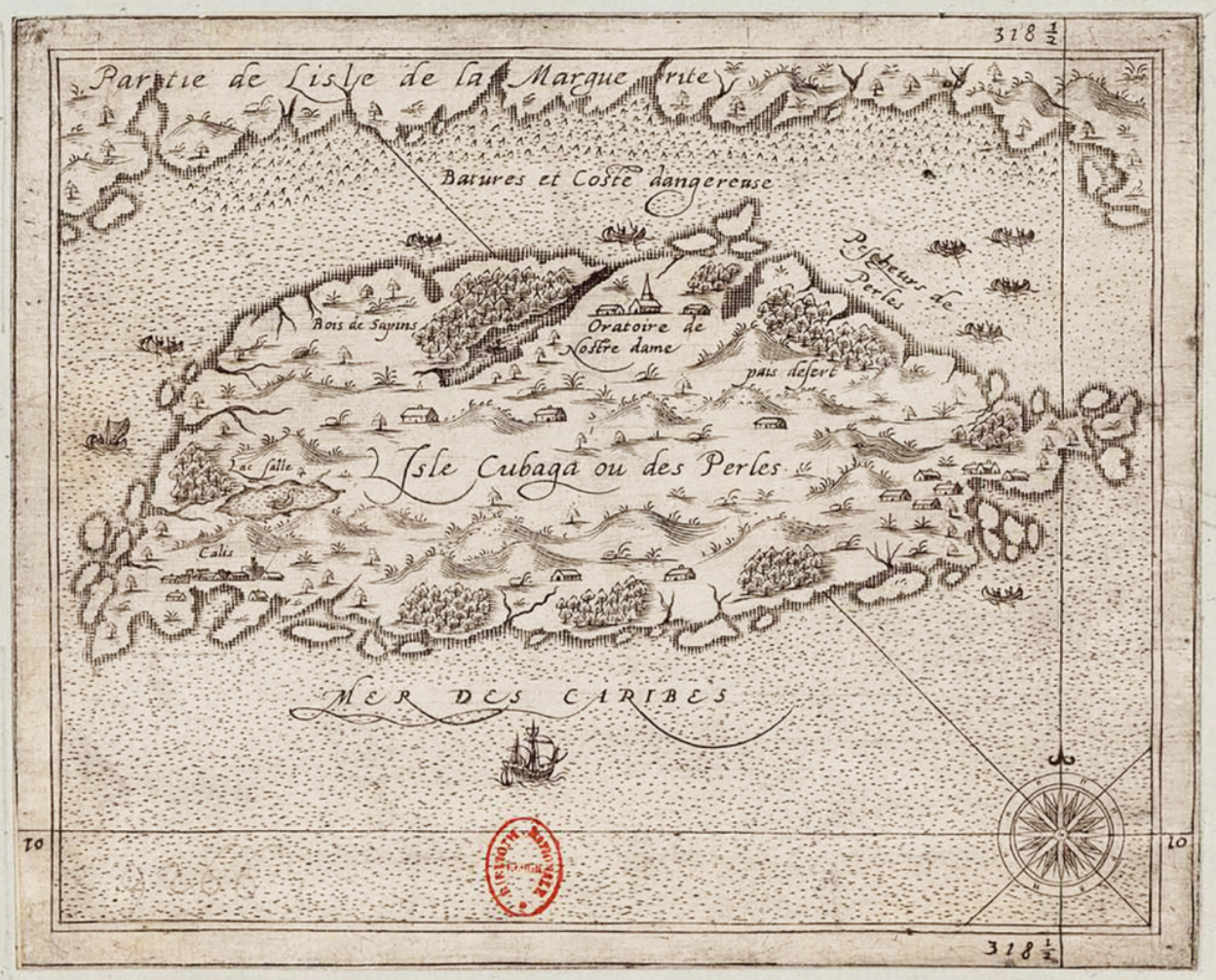
1498 — Columbus Reaches the Pearl Coast
In August 1498, during his third voyage to the Americas, Christopher Columbus entered the Gulf of Paria near the northeastern coast of South America. There, members of the expedition encountered Indigenous communities adorned with large natural pearls gathered from the surrounding seas.
In his writings, Columbus described the inhabitants as wearing pearls around their necks:
"…traían perlas al pescuezo… horadadas… no con mucho primor…"
"…they wore pearls around their necks… drilled… though not with great refinement…"
These observations are among the earliest European descriptions of drilled natural pearls in the Caribbean region and provide an important historical point of comparison with several pearls examined within the collection.
Columbus quickly recognized the economic significance of the region. The sight of pearls was enough to compel him to send men ashore to obtain some, though he himself, suffering from a monthlong bout of insomnia and severely impaired vision, remained largely incapacitated and authorized other fleet captains to go ashore first. He never set foot on Cubagua itself — the very island that would soon become the heart of the Caribbean pearl industry. This carried a significant personal consequence. Under the terms of the Capitulations of Santa Fe, signed in April 1492, Columbus had been promised ten percent of all revenues from the new lands in perpetuity — a share that explicitly included pearls, precious stones, gold, silver, and spices. The document played a major role in the mid-sixteenth century when Columbus's descendants sued the Crown for not respecting the original agreement, yet the admiral himself died in 1506 having never collected a meaningful share of the pearl wealth his own expedition had uncovered. The fortune generated by Cubagua's waters passed entirely to others.
Within only a few years, the waters surrounding Cubagua, Margarita, and the Pearl Coast would become the center of one of the earliest and most lucrative extractive industries in the Americas, transforming pearls into symbols of wealth, empire, and exploitation across the Atlantic world.
1500 — Niño Returns with Pearls
In 1500, a year after Columbus’s observations along the Pearl Coast, Peralonso Niño returned to Spain with a substantial quantity of Caribbean pearls obtained through trade and extraction along the northern coast of South America.
Contemporary accounts describe the voyage as one of the earliest highly profitable returns from the newly encountered territories of the Americas. The arrival of pearls at the Spanish court intensified royal interest in the region and helped establish the Caribbean pearl fisheries as one of the first major sources of wealth extracted from the New World.
What had begun as scattered reports of Indigenous pearl adornment quickly evolved into an expanding maritime industry centered around Cubagua, Margarita, and the surrounding coasts, drawing explorers, merchants, settlers, and the Spanish Crown into an increasingly competitive search for pearls.
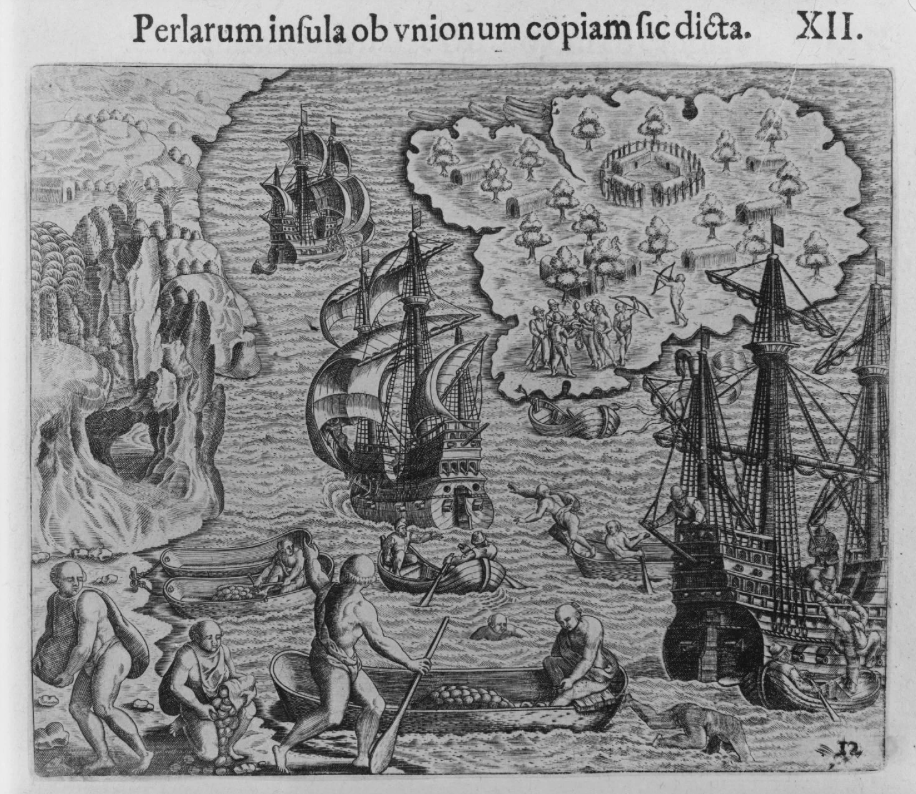
Perlarum insula ob unionum copiam sic dicta (“The Island of Pearls, so called because of its abundance of pearls”), engraving by Theodor de Bry, published in 1594 in Americae pars quarta and derived in part from the writings of Girolamo Benzoni. The image depicts Indigenous pearl divers, European ships, and the early Caribbean pearl fisheries associated with Cubagua and the Pearl Coast. Created decades after Columbus’s third voyage, the engraving reflects the growing European fascination with the immense wealth generated by the pearl fisheries of the New World.
Early 1500s — Rancherías and the First Pearl Settlements
In the first years of the sixteenth century, the search for pearls began to transform the small arid island known to the local Guaiquerí people as Charagato. Drawn by the extraordinary abundance of oysters in the surrounding waters, Spanish explorers and merchants referred to it simply as the “Island of Pearls” before the name Cubagua gradually became established in colonial records.
During the earliest encounters, relations between Europeans and the local Indigenous communities appear to have been relatively cooperative, with pearls initially obtained through trade and exchange. Indigenous divers, already familiar with the fisheries long before European arrival, played a central role in guiding and supplying the newcomers.
As European demand for pearls rapidly increased, however, these relationships deteriorated. Temporary camps and pearl-working settlements known as rancherías emerged along the coasts, evolving into centers of extraction, commerce, and control. What had begun as exchange soon intensified into forced labor, exploitation, and growing violence as the Caribbean pearl fisheries became one of the earliest engines of colonial wealth in the Americas.
The Pearl Fisheries and the Early Atlantic Economy
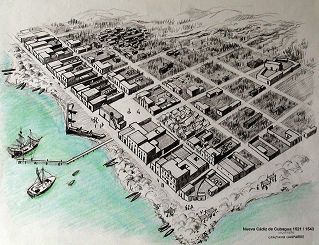
As the pearl fisheries expanded during the early sixteenth century, Cubagua evolved from a seasonal extraction zone into one of the earliest permanent European settlements in South America. Known to the Spanish as Nueva Cádiz, the settlement rose along the island’s barren coastline and depended almost entirely upon the wealth generated by pearls.
The rapid growth of the fisheries created an increasing demand for labor. At first, Spanish merchants and officials relied heavily upon the local Indigenous populations of the Pearl Coast and nearby islands, many of whom were already experienced free divers familiar with the surrounding waters. Over time, however, the scale of extraction intensified dramatically. Indigenous people from neighboring regions were transported into the fisheries, including Lucayan divers from the Bahamas, who were particularly valued by the Spanish for their underwater abilities and endurance.
As Indigenous populations declined through disease, exhaustion, displacement, and violence, enslaved Africans from West Africa were increasingly introduced into the Caribbean labor system. The pearl fisheries of Cubagua and the surrounding coast therefore became part of one of the earliest transitions from Indigenous forced labor to the large-scale use of enslaved African labor in the Americas, marking the beginning of a far broader Atlantic system of extraction, slavery, and imperial commerce.
Despite the island’s lack of fresh water, agriculture, and natural resources, Nueva Cádiz grew into one of the wealthiest ports of the early Spanish Atlantic world. Ships arrived carrying merchants, royal officials, supplies, enslaved laborers, and fortune seekers drawn by the extraordinary value of pearls. Beneath this prosperity, however, lay an increasingly fragile system built upon environmental depletion, dangerous diving conditions, and human exploitation on a massive scale.
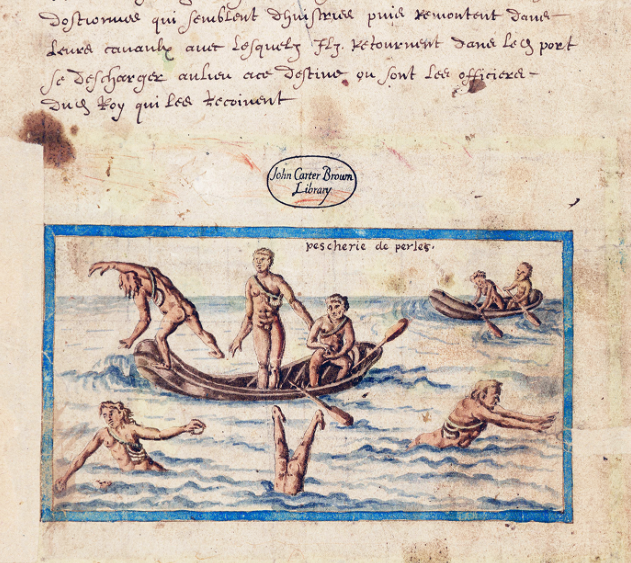
Navigating Labour Shifts: Early Modern Pearl Fishing in the Caribbean (1521–1563) | International Review of Social History | Cambridge Core
Bartolomé de las Casas and the Pearl Fisheries
Few contemporary witnesses described the human cost of the Caribbean pearl fisheries more vividly than Bartolomé de las Casas. Arriving in the Americas during the early years of Spanish colonization, Las Casas documented the conditions endured by Indigenous pearl divers along Cubagua and the surrounding coasts with unusual detail and moral outrage.
Las Casas claimed the horrors of pearl diving exceeded even those of laboring in the silver mines on the American mainland. The dangers were considerable: exploding eardrums, shark attacks, and a punishing whip for divers who moved too slowly or failed to deliver the right number of oysters to the boat. Skin infections, open wounds, jellyfish stings, and inflammation were common. Some divers simply disappeared beneath the surface.
Writing in the sixteenth century, he described exhausted divers forced to descend repeatedly into dangerous waters in search of oysters while under the control of overseers driven by the relentless demand for pearls. In one of his most cited passages, Las Casas wrote:
“La tiranía que los españoles ejercen contra los indios para sacar o pescar perlas es una de las más crueles y condenables cosas del mundo…”
“The tyranny the Spaniards exercise against the Indians in gathering or fishing for pearls is one of the cruelest and most condemnable things in the world…”
He also described divers remaining underwater for extended periods, suffering from exhaustion, malnutrition, shark attacks, and severe physical punishment. According to Las Casas, many died from the conditions surrounding the fisheries, while others were permanently injured or driven to desperation.
Las Casas transformed the pearl into a moral indictment. Every gem, he insisted, had been bought with a human life. He spent fifty years actively fighting slavery and colonial abuse, trying to convince the Spanish court to change its policies in the Indies.
His writings remain among the most important historical testimonies concerning the early Caribbean pearl industry and provide a rare contemporary account of the human suffering that accompanied one of the first major extractive economies of the Americas.
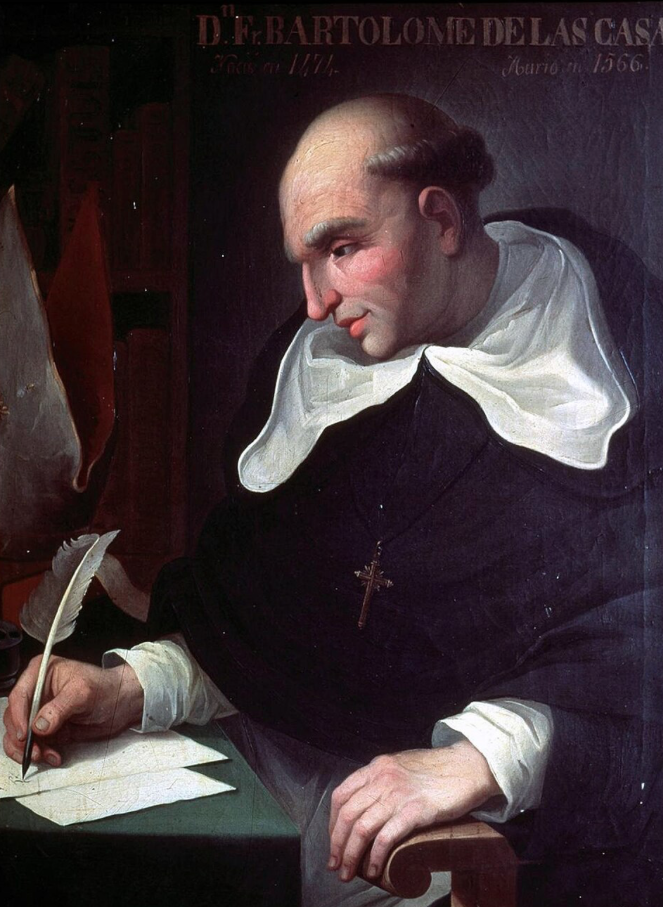
Portait of Bartolomé de Las Casas - unidentified painter
Decline and Collapse
By the 1530s, decades of intensive harvesting had severely depleted many of the oyster beds surrounding Cubagua. Divers were forced to search farther from the island and descend into increasingly dangerous waters as the most productive fisheries began to decline. At the same time, the harsh conditions of labor, disease, over exploitation, and shifting trade routes placed growing pressure upon Nueva Cádiz and the broader pearl economy.
Environmental exhaustion was accompanied by instability across the region. Storms, hurricanes, and periodic flooding repeatedly damaged the fragile settlement, whose survival depended almost entirely upon maritime commerce and the fisheries themselves. As production diminished, merchants and settlers gradually redirected their attention toward newer pearl grounds along the South American mainland and other parts of the Caribbean.
In 1541, following a destructive hurricane and the continuing collapse of the fisheries, Nueva Cádiz was largely abandoned. What had once been one of the wealthiest settlements in the early Spanish Atlantic world slowly disappeared beneath sand, salt, and time, leaving behind the ruins of one of the earliest extractive colonial economies in the Americas.
Pearls, Commerce and Taxation
Historical records from the sixteenth century indicate that the pearl fisheries of Cubagua and the surrounding Caribbean coast generated enormous quantities of wealth for the Spanish Empire during the earliest decades of Atlantic expansion. Research based on archival sources, including the work of historian Enrique Otte, estimates that approximately 11,877 kilograms of pearls were extracted from the fisheries between 1513 and 1540. Otte himself used the quinto yield on pearls as his primary guide to estimating total fisheries output, which means the true volume of production almost certainly exceeded what official records captured.
The scale of this production carried significant environmental consequences. Because natural pearls occur only rarely within pearl oysters, the recovery of large quantities of marketable pearls required the harvesting and opening of immense numbers of oysters over relatively short periods of time. Archaeological shell deposits and historical descriptions from the region suggest that the fisheries surrounding Cubagua experienced rapid and intensive ecological depletion, making them among the earliest documented examples of large-scale marine resource exhaustion caused by Europeans in the Americas, with the Margarita and Cubagua fisheries substantially depleted within just forty years of discovery.
At the same time, Caribbean pearls altered existing commercial networks linking Europe to luxury goods. Prior to the discovery of the American fisheries, many of the finest pearls entering European markets had arrived through trade routes connected to the Persian Gulf, the Indian Ocean, and Mediterranean centers such as Venice. During the sixteenth century, however, Seville emerged as the principal Atlantic port through which pearls and other American commodities entered the Spanish imperial economy. By law, the colonies could trade only with Seville, the one designated port in the mother country, a monopoly arrangement that concentrated the pearl trade within a single, Crown-controlled channel.
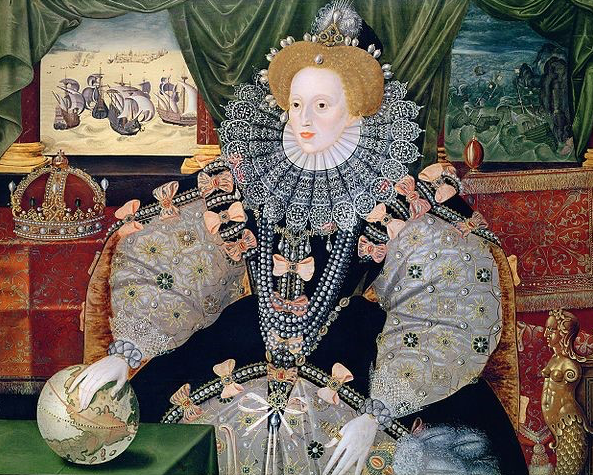
Spanish authorities developed increasingly sophisticated systems for the classification, taxation, and regulation of pearls. The principal fiscal instrument was known as El Quinto Real — the Royal Fifth — a tax reserving to the monarch 20% of all precious metals and other commodities acquired by his subjects as war loot, found as treasure, or extracted by mining or fishing. The name was arithmetically precise: one fifth equals exactly 20%. Pearls were specifically subject to this quinto real, shaping their economic importance and the distribution of colonial wealth. Contemporary inventories and fiscal records categorized pearls according to size, shape, luster, and quality using commercial terms such as aljófar, pedrería, cadenilla, avemarías, and berruecos. Pearls circulated through royal treasuries, ecclesiastical institutions, aristocratic collections, jewelry workshops, and broader commercial markets throughout Europe.
Yet the quinto system was pervaded by evasion from the outset. Measuring pearls by weight was at best an imprecise and ineffective way of ensuring the monarchy received its best specimens, given the tremendous variety in shapes, sizes, luster, and color — the tax assessed quantity rather than quality. Operators routinely concealed the finest individual gems before weighing, under-reported yields, and smuggled pearls outside official channels entirely. Some merchants resorted to contraband to transport their cargoes untaxed, a practice that maritime archaeology has confirmed, showing that quantities of goods transported were sometimes higher than those recorded in official archives. Illegal trade and tax fraud marked both coastal and internal commerce throughout the empire, with contraband commonly described by colonial authorities as a "cancer" that ate away at legitimate royal revenues and eroded the moral fiber of Spanish vassals. For pearls — small, portable, easily concealed in clothing or ship timbers — such evasion was particularly tempting and particularly difficult to police.
The rapid expansion of the fisheries also intensified the demand for labor. Lucayan divers from the islands north of Hispaniola were among the most prized workers, auctioned for between 100 and 150 Spanish castellanos due to their exceptional diving abilities — valued at far more than ordinary indigenous laborers on other islands. As local populations declined through disease, displacement, exhaustion, and violence, enslaved Africans became the labor of choice in the pearl fisheries by the mid-sixteenth century. The pearl economy of Cubagua therefore occupied a significant place within the early development of Atlantic systems of extraction, labor, taxation, and imperial commerce — a system whose official numbers, even at their most impressive, told only part of the story of what was truly taken.
Kaara Peterson: Oxford University's “pendant pearl” portraits of Queen Elizabeth I | Centre for Early Modern Studies
Beyond Pearls: Cubagua's Forgotten Black Gold
The island, once known as Charagato, Rich Island, Pearl Island, and ultimately Cubagua, possessed no permanent source of fresh water, no forests, little vegetation, and no game. Ironically, this barren outcrop not only concealed the richest known pearl beds of the sixteenth century, but also the earliest documented petroleum seeps in the Americas.
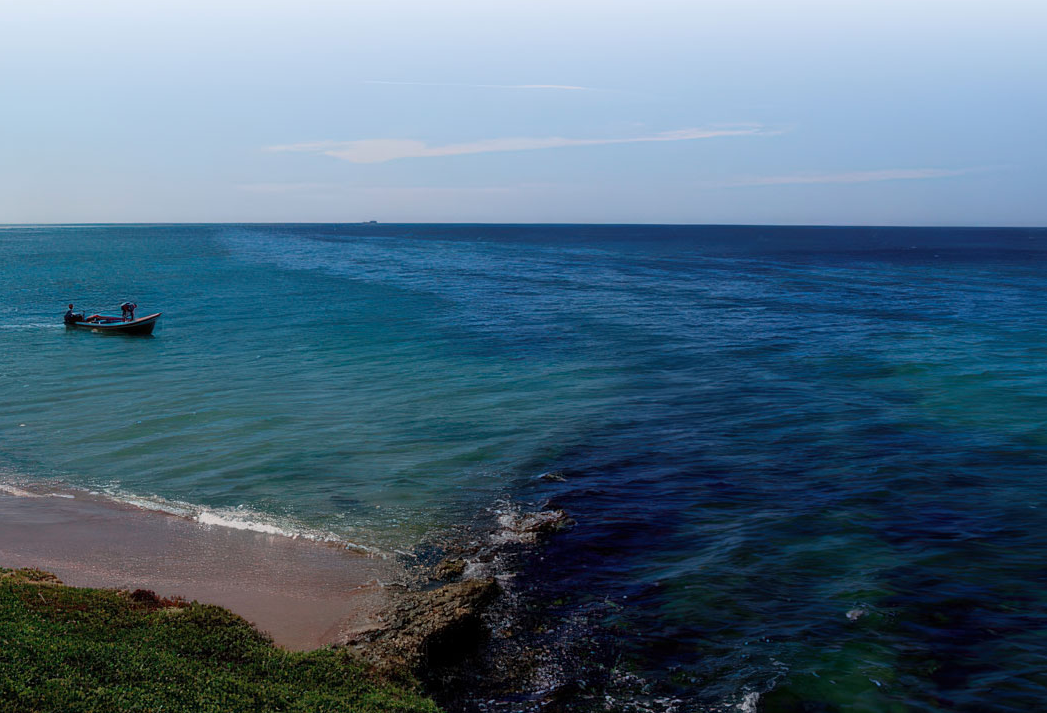
At Cubagua's western tip, a black, glossy, foul-smelling substance slowly seeps from the earth and spreads across the surface of the sea. The Guaiquerí had long collected this natural bitumen to waterproof and repair their canoes, and other Indigenous communities in northern Venezuela also used naturally occurring petroleum for illumination, adhesives, and other practical purposes. While European shipwrights had for centuries caulked their vessels with pine pitch, tar, and resins, it was almost certainly through observing this Indigenous practice that the Spaniards first recognized the value of naturally occurring petroleum for the same purpose. The chronicler Gonzalo Fernández de Oviedo described the strange substance in 1535, recording that some Spaniards called it Stercus Demonis—"The Devil's Excrement"—because of its appearance and overpowering odor. Others simply knew it as asphaltum or bitumen. Despite its sinister name, it became highly valued for caulking vessels and was widely believed to possess medicinal properties, particularly for treating gout and rheumatic ailments. So valuable was the seep that in 1532 the Spanish Crown officially authorized the inhabitants of Cubagua to use it, and within a few years petroleum collected on the island was shipped across the Atlantic for medicinal use in Spain, making it the earliest documented petroleum export from the Americas.
Remarkably, the seep has never disappeared. More than five centuries later, the mene de La Brea still bubbles up at Punta La Brea, where black petroleum continues to reach the shoreline much as it did when the first Europeans arrived. The pearls are gone. The Guaiquerí are gone. The Spaniards are gone. The immense mountains of discarded pearl oyster shells have disappeared, and the once-prosperous streets and stone buildings of Nueva Cádiz lie in ruins. Yet the ancient seep remains, quietly emerging from the earth as it has for countless centuries—a silent witness to Cubagua's extraordinary past.
Punta La Brea - Cubagua Photo courtesy of Kum and Lopez
The active petroleum seep at Punta La Brea, Cubagua. More than five centuries after Gonzalo Fernández de Oviedo described this natural bitumen source, the oil still reaches the sea, forming a dark surface slick much as it did during the early sixteenth century.