Ponce de León
Juan Ponce de León, the Pearl Coast, and the Road to Florida
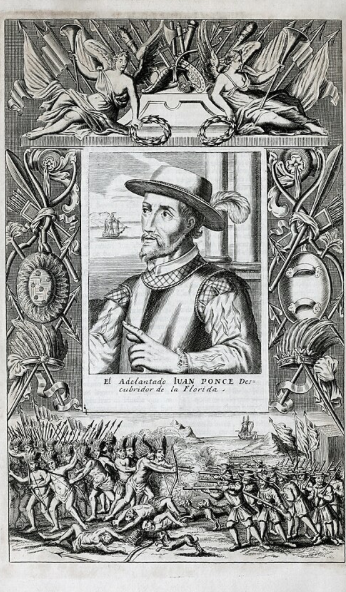
The story of Juan Ponce de León has been told, for five centuries, as a story about a fountain. It is not. It is a story about pearls, about political betrayal, about the calculated ambitions of a king who needed loyal men to push his empire beyond the reach of a dead admiral's heirs, and about an indigenous world that was already deeply, violently aware of what the Spanish were before a single Spanish ship appeared on the horizon of Florida.
Ponce de León was not a romantic fool chasing rejuvenating waters through subtropical swamps. He was one of the most capable administrators and military commanders in the early Spanish Caribbean — a man who had spent two decades at the operational center of the colonial world, who had governed the island through which the first Caribbean pearl revenues flowed, who knew exactly what the Pearl Coast had produced and what it had cost, and who was redirected northward not by legend but by the coldly strategic calculation of a king who needed new territory beyond the reach of a legal dispute.
The Fountain of Youth was invented. The connections are real.
A Career Built in the Shadow of Pearls
Ponce de León arrived in the Caribbean in 1493 as a young gentleman volunteer on Columbus's second voyage. The fleet anchored briefly off the coast of the island the natives called Boriquén — present-day Puerto Rico — before continuing to Hispaniola, giving Ponce de León his first glimpse of a place that would define his career. He settled on Hispaniola and spent the next decade building his standing in the colonial government, distinguishing himself in military engagements against the Taíno, and cultivating the patronage of Governor Nicolás de Ovando, who arrived in 1502 with a mandate to bring order to a colony that Columbus had left in chaos.
It was on Hispaniola, during the years between 1502 and 1508, that Ponce de León lived at the administrative heart of the Caribbean pearl economy.
The connection is not metaphorical. It is logistical and chronological. The pearl fisheries at Cubagua were organizing in precisely these years — from the first seasonal camps after 1500, through the rapid expansion of the early 1500s, to the beginning of systematic pearl shipments that would peak in the 1520s. In the critical first decade of those operations, the administrative hub for everything related to Cubagua was Santo Domingo on Hispaniola. Pearl cargoes from Cubagua and the Pearl Coast were transported to Hispaniola before being shipped onward to Seville. The labor supply for Cubagua's diving operations — first the local Guaiqueri and other indigenous peoples of the Pearl Coast, then increasingly people seized from across the Caribbean — was organized through Hispaniola, administered by the colonial government in Santo Domingo, and authorized by royal decrees that passed through the island's governance structure.
In 1504, when Ponce de León was rewarded for his role in crushing the Higüey rebellion by being named provincial governor of the eastern part of Hispaniola, he assumed office at precisely the moment this entire system was being constructed around him. As provincial governor from 1504 onward, he was a senior official of the colonial government through which pearl revenues were transiting, pearl-related labor authorizations were being issued, and the commercial networks connecting Cubagua to Seville were being organized. He did not administer the pearl fisheries directly. But he inhabited the institutional world that made them possible, at the period in which they were most consequential.
Puerto de las Perlas — the settlement on the Venezuelan coast established in 1499 by Alonso Niño, the navigator whose ninety-six pounds of pearls had proved the Pearl Coast's commercial viability — was supplying fresh water to the camps on Cubagua and funneling pearl cargoes northward toward Hispaniola. The name Niño gave it was not incidental. Puerto de las Perlas — the Port of Pearls — was the mainland transit point for the most valuable commodity in the early Atlantic economy, and it reported into the same colonial administrative structure that Ponce de León served as a senior official. By 1515 this settlement would be formally established as San Francisco de Cumaná — the first city founded in continental South America — a direct institutional descendant of the pearl trade's logistical demands. The route from Cubagua's oyster beds to the markets of Seville ran through Puerto de las Perlas to Hispaniola to Spain, and Ponce de León governed the island that sat at the middle of that chain during the years when it mattered most.
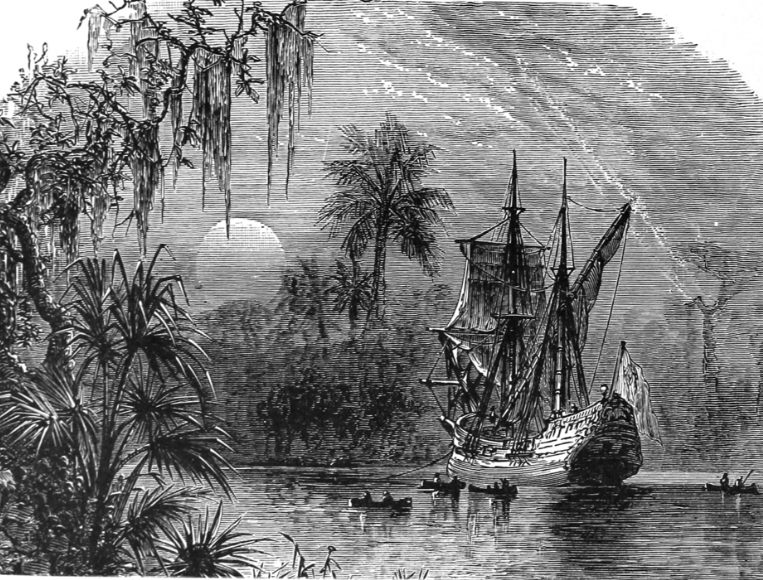
Unknown engraver - Ponce de Leon arriving in Florida
The Political Calculation That Changed a Continent
In 1508, Ferdinand II authorized Ponce de León to explore Puerto Rico — the first of several instances in which the king used him as a deliberate instrument of Crown expansion beyond the Columbus family's jurisdictional reach. The pattern was consistent: Ferdinand needed loyal men operating in territories where Diego Columbus, Christopher's son and heir to his father's sweeping titles as Viceroy of the Indies, could not legally claim authority.
When Diego Columbus won his legal battle in 1509 and arrived in Hispaniola as Viceroy, he moved immediately to displace Ponce de León from the governorship of Puerto Rico. Ferdinand backed Ponce de León, but the courts ultimately upheld Diego Columbus's authority. By 1511, Ponce de León had lost Puerto Rico. He was now a skilled, ambitious, loyal conquistador without a territory — exactly the man Ferdinand needed for the next phase of expansion.
Wikipedia's article on Ponce de León states the strategic calculation with a directness that the popular mythology of the Fountain of Youth has consistently obscured: "Rumors of undiscovered islands to the northwest of Hispaniola had reached Spain by 1511, and Ferdinand was interested in forestalling further exploration and discovery by Colón. In an effort to reward Ponce de León for his services, Ferdinand urged him to seek these new lands outside the authority of Colón."
Ferdinand did not send Ponce de León north to find rejuvenating waters. He sent him north because the political dynamics of the Caribbean colonial world — the same world that the pearl economy had made worth fighting over — had created both a displaced loyal servant and a strategic imperative to push Spanish territory beyond the Columbus family's legal reach. The royal patent Ferdinand issued in February 1512 specifies the distribution of gold, the subjugation of natives, and the Crown's fiscal share. It makes no mention of any fountain.
The political dynamics that shaped this decision were inseparable from the pearl economy. The Columbus family's hereditary claims — the claims Ferdinand now regretted and was working systematically to curtail — were worth fighting over precisely because they encompassed the Pearl Coast and the revenues of Cubagua. Without the pearl beds, the Columbus Viceroyalty would have been an inheritance of sparsely settled islands with modest gold deposits. With it, those titles represented control over the most commercially productive region in the Atlantic world. The Pleitos Colombinos — the Columbus family lawsuits that consumed three decades of litigation — were fought over pearl revenues as much as anything else. And it was the tension generated by that dispute, by Ferdinand's determination to limit the Columbus family's power, that sent Ponce de León northwest toward a continent no European had yet named.
What the Calusa Already Knew
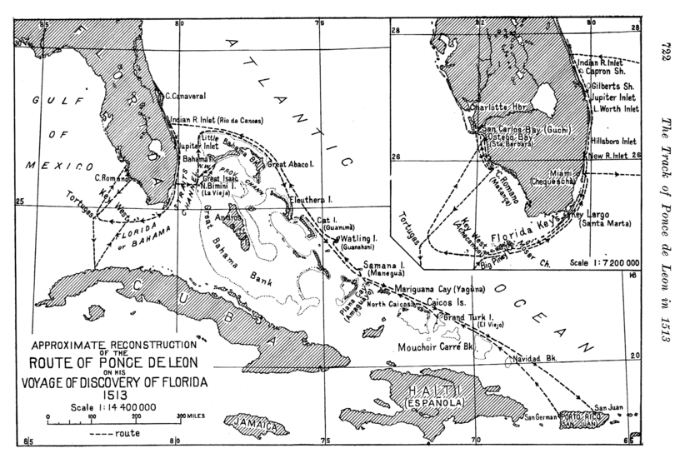
On April 2, 1513, Ponce de León's three ships made landfall on the northeast coast of the North American mainland. He named it La Florida — it was Easter week, Pascua Florida in Spanish — and claimed it for Spain. Sailing south and then around the peninsula, his ships entered the waters of southwest Florida in late May, probably anchoring near the mouth of the Caloosahatchee River or in the vicinity of Charlotte Harbor. What happened next reveals something that Ponce de León could not have anticipated and that the historical record has never fully examined: the people who came out to meet him already knew what he was.
The Wikipedia article on the Calusa states it plainly: "The Calusa knew of the Spanish before this landing, however, as they had taken in refugees from the Spanish subjugation of Cuba."
This single sentence opens a door that the conventional narrative of European exploration consistently closes. The Calusa were not an isolated people encountering strangers from beyond the edge of the known world. They were participants in one of the most extensive maritime trade and communication networks in the pre-contact Americas — a network whose archaeological traces stretch from the Florida peninsula southward through the Bahamas, the Greater Antilles, and the Lesser Antilles to the coast of South America, and whose operational capacity for moving people, goods, and information across open water had been demonstrated for at least two thousand years before Columbus arrived.
The evidence for this network is not speculative. The National Park Service's documentation of Caribbean trade routes confirms extensive circum-Caribbean and inter-island exchange systems connecting Florida, the Bahamas, the Greater Antilles, the Lesser Antilles, and the South American mainland. The Journal of Island and Coastal Archaeology has documented that the indigenous networks encountered by the Spanish in 1492 were "flexible, robust, inclusive, and outward-looking systems" with extensive capacity for moving people, goods, ideas, and information across the region. Taíno loan-words appear in the pre-Columbian languages of the Calusa and the Timucua — linguistic evidence of sustained contact. Native Cubans, according to sources cited in Ponce de León's own voyage accounts, told him about the mainland to the north before his 1513 departure — demonstrating information flow moving in both directions across the Florida Straits.
EBSCO Research Starters' article on Ponce de León's voyages records that scholars have concluded it is "nearly certain that Spanish slave hunters came to Florida from Cuba or Mexico prior to Ponce de León's voyages, thus accounting for his hostile reception." The report that at least one person who could speak Spanish approached Ponce de León's ships during his 1513 Florida visit is documented in the primary sources. Someone in southwest Florida, in 1513, spoke a European language — almost certainly acquired from contact with the Spanish world before Ponce de León's official expedition. Smallpox, carried by native people from Cuba, had preceded Ponce de León to Florida and was already working its way through indigenous communities before a single Spanish soldier set foot on North American soil.
The Lucayan people — seized from the Bahamas by the thousands to dive for pearls at Cubagua, dying in the water between the seafloor and the surface — had fled in all directions from their captors. Some escaped. Some were released. The Bahamian chain leads directly toward Florida, and the existing trade networks provided the routes. The testimony of escaped Lucayans, of Cuban refugees who had witnessed the operations on Hispaniola, of indigenous people who had seen the Guaiqueri enslaved and the Pearl Coast destroyed — this testimony moved through the same maritime communication system that had carried goods and information across the Caribbean for millennia. It arrived in Florida before Ponce de León did.
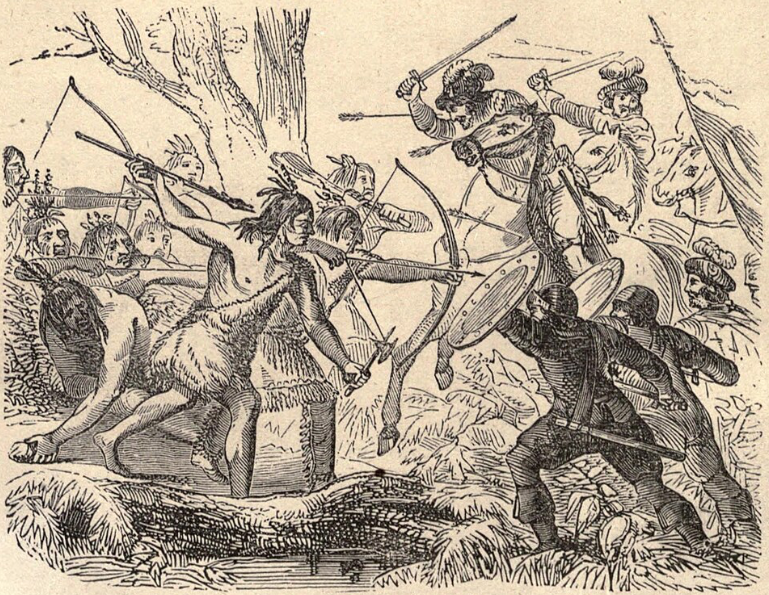
When eighty Calusa war canoes attacked Ponce de León's ships in southwest Florida in May 1513 — an assault so sustained and so organized that it forced the Spanish to retreat and return to Puerto Rico — this was not the response of a people who had never encountered Europeans and didn't know what they were. This was the response of a people who had been warned.
The Gulf Stream and What It Built
What Ponce de León discovered as his ships struggled southward along the Florida coast has proven, in the long arc of history, to be as consequential as the landfall itself. He found a river within the ocean — a massive, warm, northward-flowing current of extraordinary force, capable of stopping a fully-rigged ship dead against a favorable wind. His pilot Antonio de Alaminos understood immediately what they had found. Six years later, Alaminos used the Gulf Stream deliberately as the return route when sailing from Veracruz, Mexico, to Spain — establishing the navigation corridor that all subsequent transatlantic voyagers from the Americas would follow for centuries.
The Gulf Stream made Florida strategically indispensable. Every ship carrying the wealth of the Americas back to Spain — pearl cargoes from the Venezuelan coast, silver from Mexico, gold from Peru — needed to pass through the Florida Straits to catch the current that would carry it home. Controlling Florida meant controlling access to the highway on which the Atlantic empire's wealth traveled. This logic produced, in 1565, the founding of St. Augustine — the oldest continuously inhabited European-established settlement in the continental United States, founded forty-two years before Jamestown and fifty-five years before Plymouth Rock, specifically to defend the Gulf Stream passage and the treasure fleets that depended on it.
The pearl trade did not put Ponce de León in Florida alone. But without the pearl economy — without the revenues that made the Caribbean worth governing, without the political disputes that displaced Ponce de León from Puerto Rico, without the strategic logic that made Ferdinand need loyal men pushing into new territory — the chain of events that produced the first European landing on North American soil does not unfold as it did.
The Florida that Ponce de León named in 1513 became, in time, the southernmost state of the United States. The Gulf Stream that he documented became the engine of Atlantic navigation for three centuries. The hostile reception he received from the Calusa — delivered by people who already knew what was coming — was the beginning of a conflict that would not end until the Calusa themselves were extinguished in the second half of the eighteenth century, the last survivors of a civilization that had thrived on the Florida coast for more than a millennium before a Spanish governor looking for new territory beyond a dead man's legal claims sailed into their waters and found them waiting.