World History of Pearls
From Ancient Shores to the New World — How Pearls Shaped Civilizations, Empires, and the Course of Trade
Formed without human hands, requiring no forge or chisel, pulled from the sea by the labor of divers who risked everything in the darkness below the surface — the pearl stood apart from every other precious material in history. It was complete the moment it was found. A diamond demanded cutting. Gold demanded smelting. The pearl arrived already perfect, already whole, carried to the surface in the hands of someone who had just nearly drowned to retrieve it. For millennia, that combination — effortless beauty, mortal cost — made pearls something no other gem could claim to be. They were not merely luxury. They were proof of something. And for the civilizations that coveted them most fiercely, they were instruments of power unlike anything else the natural world had ever produced.
When Christopher Columbus encountered Indigenous peoples wearing drilled natural pearls along the coast of South America in August 1498, he was not discovering a novelty. He was finding the latest chapter in one of the longest commercial stories in human history.
LISTEN TO THIS CODEX ENTRY
Chapter 01 — The World History of Pearls
Narrated documentary version from The Columbus Pearls Audio Codex.
Runtime: 9 minutes 5 seconds
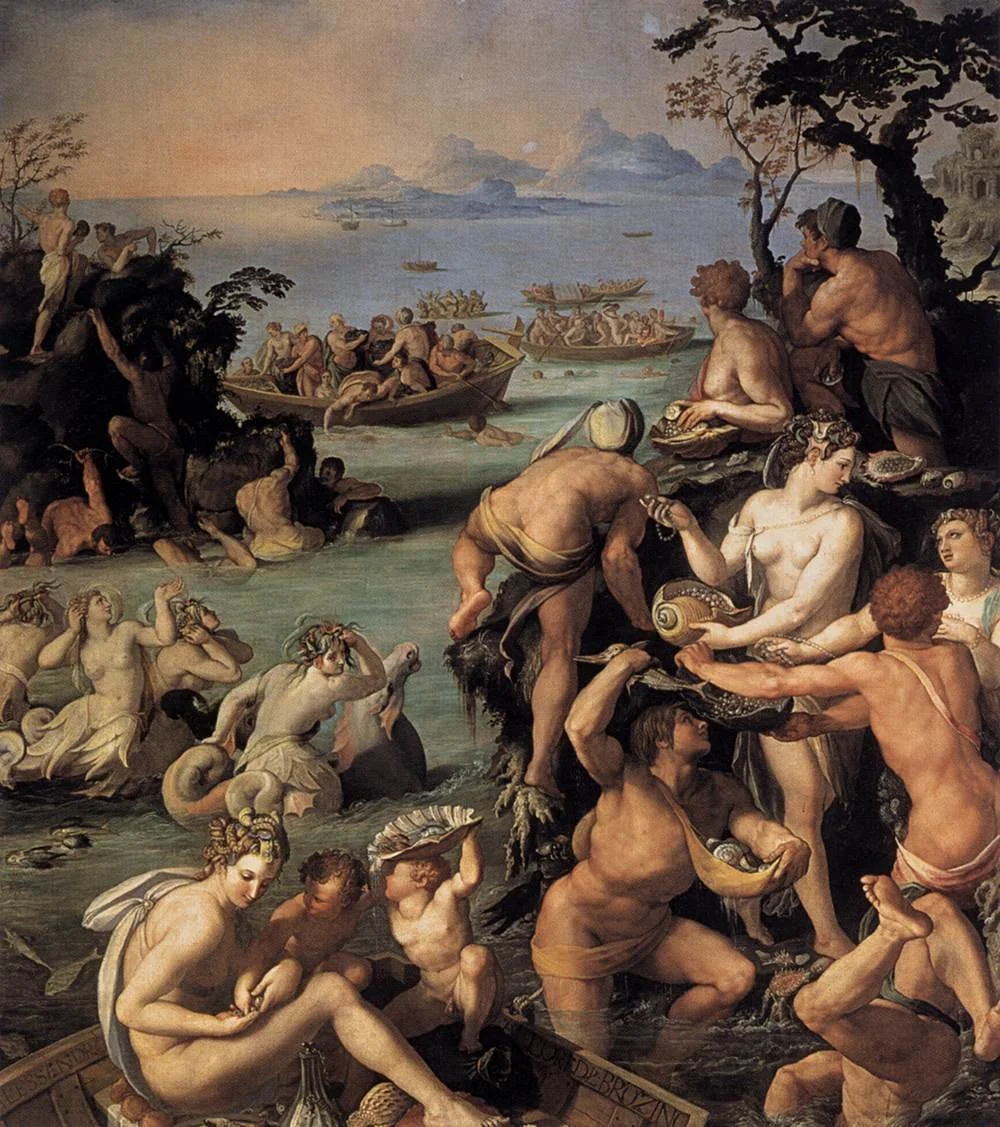
Alessandro Allori, Pescatori di Perle
The Ancient Foundations of Pearl Commerce
The three great centers of pearling in the ancient world were the Persian Gulf, the Gulf of Mannar between Ceylon and South India, and the coasts of China. Of these, the Persian Gulf was the oldest and the most deeply woven into the commercial fabric of early civilization. Trade networks operating between the Harappan and Mesopotamian civilizations as early as 2600–1900 BCE included pearls handled by merchants from Dilmun — the ancient name for what is now Bahrain and the surrounding Gulf islands — a region that would remain synonymous with pearl production for the next four thousand years.
Along these routes, pearls were never simply luxury goods. They were instruments of diplomacy, tokens of divine favor, and measures of imperial wealth. They appear in the Old Testament, the Quran, the Indian epic Mahabharata, and the ancient Epic of Gilgamesh. Persian tradition held that pearls formed when oysters rose toward the ocean's surface beneath celestial light, absorbing the essence of the moon. Indian texts linked them to divine purity and royal authority. Chinese traditions described them as symbols of wisdom and protection. Across the ancient world, pearls occupied a territory that no carved gemstone ever quite reached — they emerged from living creatures, hidden beneath dark water, and arrived already complete.
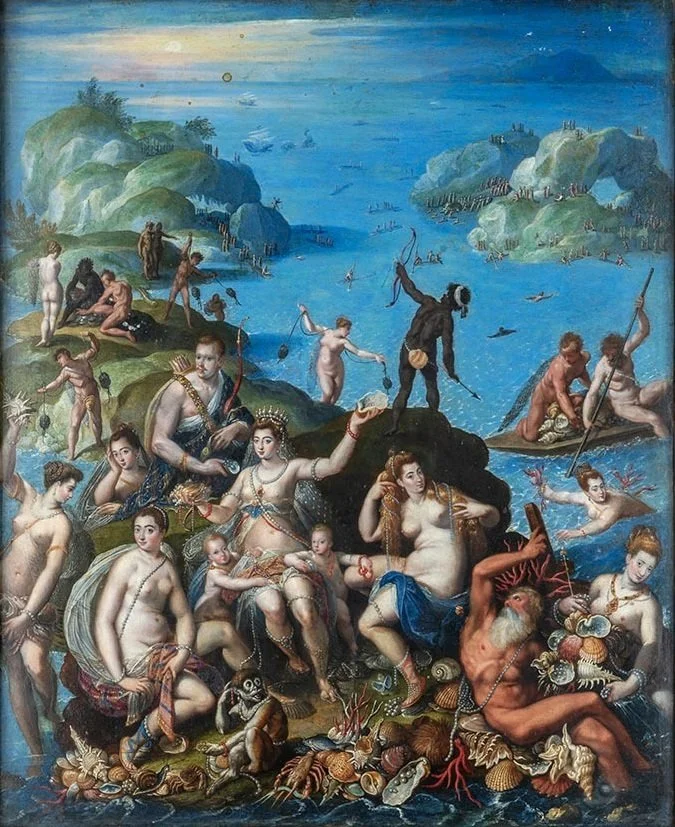
Jacopo Zucchini - c. 1585 - The Coral Fishers
Rome and the Pearl Obsession
By the time of the Roman Republic, pearls from the Indian Ocean had become the most desired commodity in the Mediterranean world. The Roman author Pliny the Elder, writing in his first-century AD Natural History, declared them holders of "the first rank and the very highest position among all valuables." But it was the general Pompey the Great who truly ignited Rome's pearl fever. After his military campaigns in Asia Minor and Armenia between 66 and 63 BC, his triumphal procession through Rome included 33 crowns encrusted with pearls, a pearl-decorated shrine, and a portrait of the general made entirely of pearls. Pearls had become more than ornament — they were proof of conquest, a physical demonstration that Rome could reach the farthest ends of the known world and bring its treasures home.
The Roman fascination found its most enduring expression in a single Latin word: unio. Roman writers used it specifically for a pearl of exceptional size and quality, and the choice of word was deliberate. Unio means, simply, "one" — unique, singular, without equal. No two pearls are ever exactly alike, and Roman culture understood this instinctively. A ruby could be matched. A sapphire could be replicated in size and color. A pearl of the first rank could never be duplicated. It was, by definition, alone in the world.
Julius Caesar understood this perfectly. He ruled that women beneath a certain rank could not wear pearls, restricting them to those of designated position and age — a sumptuary law that, by making pearls the explicit marker of Roman aristocratic status, only increased their desirability. Caesar himself dedicated a breastplate made entirely of British pearls to Venus Genetrix, linking Roman military ambition directly to the global pearl trade.
No story from the ancient world captures the pearl's power more vividly than the account of Cleopatra VII recorded by Pliny. According to his telling, Cleopatra wagered Mark Antony that she could consume the wealth of an entire nation in a single meal. Antony accepted. At the banquet, Cleopatra removed one of her enormous pearl earrings — said to be among the largest pearls in the known world, valued at ten million sesterces — dropped it into a vessel of strong vinegar, and, when it had dissolved, drank it before her guests. The other earring, Pliny notes, was later cut in two and hung as pendants in the Pantheon in Rome, so that the memory of the wager would endure.
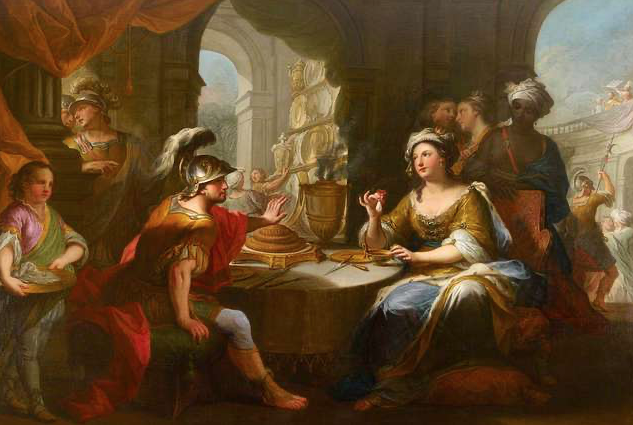
Francesco Trevisani's Banquet of Mark Antony and Cleopatra (1717)
Historians have debated the literal truth of the account ever since. A pearl is composed primarily of calcium carbonate and can indeed dissolve in an acidic solution, though not with the theatrical speed the story implies. But the historical accuracy almost becomes secondary. The story survived for two thousand years because it captured something essential about Cleopatra herself — her intelligence, her theatricality, her absolute command of political spectacle — and about the pearl's unique place in the ancient imagination. Only a pearl could serve as the currency of such a wager. Only a pearl, dissolved and drunk, could be both destroyed and consumed, made simultaneously into nothing and into everything.
The Pearl Roads of the Medieval World
The collapse of the Western Roman Empire redirected the pearl trade rather than ending it. Through the medieval centuries, the great markets of the Persian Gulf continued supplying luxury goods to the Islamic world, to Byzantium, and eventually to the rising merchant cities of northern Italy. From the 8th until the 15th century, Venetian and Genoese merchants held a near-monopoly on European trade with the Middle East, and the silk and spice routes that made these city-states phenomenally wealthy carried pearls alongside them.
Merchants at Hormuz traveled to Julfar and Bahrain to buy Gulf pearls for redistribution across India and the Mediterranean. The chain was long, the markups at each stage substantial, and the final consumers — European courts, the Catholic Church, the emerging merchant class — paid accordingly. Pearls adorned royal crowns and cathedral reliquaries alike, stitched into ecclesiastical vestments and gleaming from the painted portraits of the Renaissance's newly prosperous families.
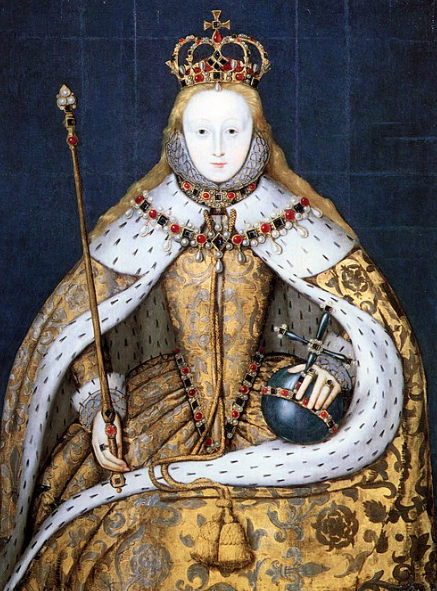
Queen Elizabeth I Coronation
Elizabeth, Gloriana, and the Pearl as Political Instrument
No monarch in European history deployed the pearl more deliberately or more brilliantly than Elizabeth I of England. By the time of her death in 1603, her wardrobe contained more than three thousand gowns, and her collection of pearls was among the most extraordinary ever assembled by a private individual. She wore them constantly — ropes of them wound through her elaborately constructed hair, cascading across the bodices of her gowns, sewn in constellations across her sleeves and ruffs. In portrait after portrait, pearls appear not as decoration but as statement.
The symbolism was carefully chosen and rigorously maintained. The pearl, long associated with purity and the moon, became under Elizabeth a living emblem of the Virgin Queen — of chastity, singularity, and power held without a husband's authority behind it. To be seen wearing pearls in Elizabethan England was to align yourself, however modestly, with the image the Queen had constructed around herself. Elizabeth understood exactly what she was doing. Her court painters were given precise instructions. The pearls were always visible. They were always prominent. They were never incidental.
Her obsession was not merely symbolic, however. Elizabeth actively sought pearls as tribute, as gift, and as political currency. When Mary Queen of Scots was captured, Elizabeth acquired her famous rope of black pearls — a transaction that carried enormous political weight, transferring not only a treasure but a symbol of fallen queenship from one monarch to another. The pearls that came flooding into Europe from the Caribbean pearl fisheries of the Spanish Empire fed Elizabeth's court as surely as they fed the Spanish treasury, finding their way through the networks of trade, theft, and diplomacy that connected the New World's oyster beds to the crowned heads of Europe.
A New World Breaks the Old Order
When Ferdinand and Isabella dispatched Columbus westward in 1492, they explicitly charged him with finding pearls alongside gold and silver. The commission was not incidental. Pearls were among the most commercially understood luxury commodities in the world, with established markets, grading systems, and buyers already in place across Europe, the Middle East, and Asia. Finding them in the Americas would mean finding wealth that could be immediately converted into imperial capital. Columbus did not succeed immediately, it took him six years from his first departure — but what he finally found along the coast of South America in 1498 would redirect the global pearl trade as decisively as Pompey's conquests had done fifteen centuries before.
The old world of pearl commerce, built slowly over millennia across the Indian Ocean, was about to be overtaken by a small, windburned island off the coast of Venezuela called Cubagua — and the extraordinary waters that surrounded it.