The Pearl Coast
From Columbus's First Sighting to the Island the World Would Come to Covet
On the morning of July 31, 1498, a sailor perched in the crow's nest of Christopher Columbus's flagship caught sight of three mountain peaks rising from the sea. Columbus, who had vowed before departure to name his next discovery after the Holy Trinity, took the three summits as a sign. He called the island La Trinidad. He had no way of knowing that the waters he was about to sail into — warm, green, and immeasurably alive — contained one of the greatest concentrations of natural pearls the world had ever produced. He had no way of knowing that what he found over the next three weeks would set off a chain of events that would reshape the global economy, destroy the people who had lived there for millennia, and exhaust, within a single generation, a marine environment that had taken thousands of years to form.
He would sail away and never return. And he would die without ever receiving the wealth those waters had promised.

Through the Serpent's Mouth
Columbus entered the great body of water beyond Trinidad through a narrow, roiling strait he named the Boca del Sierpe — the Serpent's Mouth. The passage was violent. Opposing currents, driven by the massive freshwater outflow of the Orinoco River pressing outward against the salt sea, created churning, unpredictable waters that battered his ships and alarmed his crew. He was suffering badly himself: a month-long bout of insomnia had damaged his eyesight, leaving him partly blind, dictating his observations rather than writing them himself.
But what he found on the other side of the Serpent's Mouth was, by the account preserved by Bartolomé de las Casas, something close to paradise. The Gulf of Paria — the wide, warm body of water enclosed between Trinidad and the South American mainland — was calm, green, and inhabited by people who showed no fear of the strangers arriving in tall ships. On August 5, Columbus and his captains landed on the Paria Peninsula. One captain planted a cross; another recorded that Columbus himself came ashore to formally claim the province for Spain. It was the first time a European had set foot on the South American mainland.
The people they encountered wore pearls. Las Casas, preserving Columbus's own words in his Historia de las Indias, recorded the Admiral's observation directly: "Traían al pescuezo collar de perlas y entre ellas venían algunas muy gordas" — "They wore around their necks collars of pearls, and among them were some very large ones." They also wore ornaments of guanin, an alloy of gold, silver, and copper long used in trade across the region. Columbus, whose eyes were giving out, sent men ahead to obtain pearls by barter. They returned with enough to confirm what he had suspected. He wrote to Ferdinand and Isabella describing these lands as among the richest he had encountered, calling the Gulf of Paria Tierra de Gracia — the Land of Grace — and describing its beauty so fervently that he believed he had arrived at the very threshold of the earthly paradise.
The People of the Water
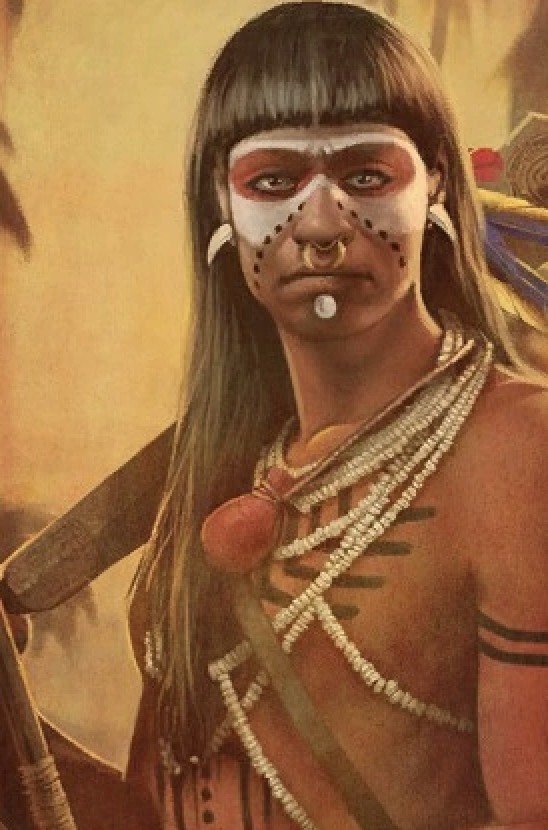
The pearls Columbus found along the Paria coast were not the product of chance. They were the product of a people who had lived in intimate relationship with these waters for thousands of years.
The Guaiquerí — whose name translates roughly as "the People of the Water" — were the indigenous inhabitants of the islands and coastline of what is now northeastern Venezuela: Margarita, Cubagua, Coche, and the Araya Peninsula along the nearby mainland. They were not primarily farmers. They were fishermen, navigators, and maritime traders of exceptional skill, people whose entire civilization had been organized around the sea. They moved across it in canoes, knew its seasonal moods, read its currents, and had developed over generations an intimate knowledge of where the pearl oyster beds lay and how to reach them safely.
Archaeology confirms that the first human settlement on Cubagua dates to around 2325 BCE — more than four thousand years before a European ship ever appeared on that horizon. The Guaiquerí had not merely visited these waters. They had lived alongside them, fished them, and understood them in ways that no arriving Spaniard ever would.
When Columbus's men came ashore, the Guaiquerí met them with openness. They brought out pearls willingly, calling them “thenocas” or “coxicas”, trading them for the painted ceramic fragments, glass beads, and metal trinkets the Europeans offered — goods the Guaiquerí had no prior reason to value, but accepted as gestures of exchange between strangers. There was, in those first encounters, a quality of genuine reciprocity. The Guaiquerí saw in the pale-skinned men with their gleaming armor something they could not yet interpret as a threat. According to later accounts, some among them believed the strangers might be sons of the sun, arriving from a world beyond the sea. They welcomed them accordingly.
It was a generosity that would cost them everything.
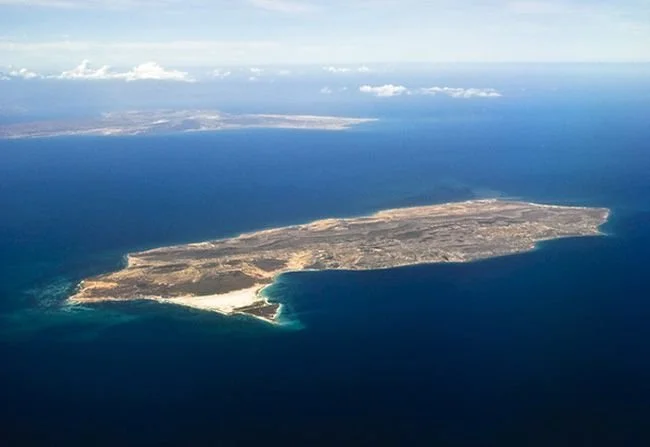
The island they called Charagato — the small, flat, waterless place the Guaiquerí had known across generations — would soon be renamed by the Spanish the Isla de las Perlas: the Island of Pearls. The renaming was not incidental. In the Spanish colonial imagination, Cubagua was not a place where people lived. It was a place where pearls came from. The Guaiquerí, who had stewarded those waters for millennia, did not figure into that accounting.
Cubagua Sighted — and Left Behind
On August 15, 1498, sailing westward along the northern coast of Paria after his encounters with the pearl-wearing people of the gulf, Columbus sighted two islands in the distance. One was Margarita — a name he chose deliberately, the Latin word for pearl. The other was the small, flat island the Guaiquerí called Charagato, which Columbus sighted and noted but did not approach. He was in deteriorating health, the fleet was running low on provisions, and Hispaniola — where the Spanish colony was descending into revolt — was pulling him northwest. He noted the pearl-diving activity in the surrounding waters and sailed on.
It was, in retrospect, one of the most consequential decisions in the history of the Americas. He had seen the island. He had bartered for pearls along its coast. He had written to his monarchs about the extraordinary abundance of these waters. And then he sailed away from the greatest pearl fishery in the history of the world without fully grasping what he was leaving behind for others.
The historian Frederick Ober, writing in the nineteenth century, captured the moment with a plainness that has never been improved upon: "If someone could only have whispered to Columbus a hint of the riches those waters contained, he might have made that third voyage the most prosperous of all."
The Man Who Opened the Door
Columbus returned to Hispaniola in August 1498 to find the colony in open rebellion. He spent the next two years attempting to govern an ungovernable situation, was arrested by the royal investigator Francisco de Bobadilla in 1500, and was shipped back to Spain in chains — stripped of his titles, publicly humiliated, the Admiral of the Ocean Sea arriving at the docks of Cádiz in irons. He was eventually pardoned and granted a fourth voyage, but his authority over the territories he had discovered was never restored. Queen Isabella, his most steadfast patron, died in November 1504, just three weeks after Columbus returned to Spain for the last time. He spent his final years in Valladolid, ill and increasingly embittered, attempting repeatedly to secure an audience with King Ferdinand to demand the honors and revenues he believed he was owed. Ferdinand never received him.
He died on May 20, 1506. His funeral procession through the streets of Valladolid passed unnoticed by the city's residents. The king who owed him so much did not even learn that Columbus was ill before he died.
The question of what Columbus was owed had a precise legal answer — or should have had one. The Capitulations of Santa Fe, signed between Columbus and the Catholic Monarchs in April 1492, had promised him a tenth of all revenues — pearls, gold, silver, spices — obtained within the limits of his admiralty. The language of the agreement was specific: riches "bought, bartered, found, acquired, and possessed" in those seas were subject to his diezmo, his tenth. But the Capitulations also bound that entitlement to his role as Viceroy and Governor of the lands he discovered. When the Crown stripped him of those offices in 1500, it used that linkage as its legal justification to deny him the revenues that followed. Cubagua's pearl beds fell within the admiralty Columbus had been granted. But Columbus had never governed the island, had never set foot on it, and had been removed from authority before its fisheries were formally organized. The Crown had its argument. The tenth Columbus was owed from the greatest pearl fishery in the world was never paid.
His heirs would spend the next thirty years litigating what he had been promised, in a series of lawsuits known as the Pleitos Colombinos. They received partial compensation, a modest annual pension, and the island of Jamaica as a hereditary seigneury. The pearl revenues of Cubagua — which at their peak produced an estimated twenty-five hundred kilos of pearls per year and generated fortunes that helped finance the Spanish Empire — enriched the Crown, the merchants of Seville, and the slavers who organized the diving operations. They did not enrich the man who had first seen those waters and understood, even through failing eyes, that something extraordinary lay beneath their surface.
A curious note not related to pearls, but to Cubagua itself.
The island, once known as Charagato, Rich Island, Pearl Island, and ultimately Cubagua, possessed no permanent source of fresh water, no forests, little vegetation, and no game. Ironically, this barren outcrop not only concealed the richest known pearl beds of the sixteenth century, but also the earliest documented petroleum seeps in the Americas.
At Cubagua's western tip, a black, glossy, foul-smelling substance slowly seeps from the earth and spreads across the surface of the sea. The Guaiquerí had long collected this natural bitumen to waterproof and repair their canoes, knowledge the Spaniards almost certainly observed and soon put to practical use themselves. The chronicler Gonzalo Fernández de Oviedo described the strange substance in 1535, recording that some Spaniards called it Stercus Demonis—"The Devil's Excrement"—because of its appearance and overpowering odor. Others simply knew it as asphaltum or bitumen. Despite its sinister name, it became highly valued for caulking vessels and was widely believed to possess medicinal properties, particularly for treating gout and rheumatic ailments. So valuable was the seep that in 1532 the Spanish Crown officially authorized the inhabitants of Cubagua to use it, and only a few years later petroleum collected on the island was shipped across the Atlantic for medicinal use in Spain, making it the earliest documented petroleum exports from the Americas.
Remarkably, the seep has never disappeared. More than five centuries later, the mene de La Brea still bubbles up at Punta La Brea, where black petroleum continues to reach the shoreline much as it did when the first Europeans arrived. The pearls are gone. The Guaiquerí are gone. The Spaniards are gone. The great mountains of discarded pearl oyster shells have vanished, and the once-prosperous stone city of Nueva Cádiz lies in ruins. Yet the ancient seep remains, quietly emerging from the earth as it has for countless centuries—one of the last living witnesses to Cubagua's extraordinary past.
What Made Cubagua Possible
The question that Columbus never asked — and that the Spanish colonizers who followed him never thought to ask — was why. Why here? Why did this particular flat, arid, waterless island, with no soil and no rivers and nothing on its surface to recommend it, produce pearls in a quantity and quality that no other place in the world could match?
The answer lay not in the island itself but in the waters surrounding it: in a set of oceanic and climatic conditions so specific, so precisely calibrated, and so biologically extraordinary that they exist nowhere else on earth in quite the same combination — and which the Atlantic pearl oyster had, over millennia, evolved to exploit with perfect efficiency.
Understanding those waters — their seasons, their temperatures, their currents, and the ancient geological basin that drives them — is the key to understanding everything that happened on Cubagua, and everything that the Columbus Pearls carry within them.