Blood for Pearls
The Human Cost of the Caribbean Pearl Fisheries
There is a question that never appears in the royal ledgers of Nueva Cádiz, never surfaces in the customs records tallying pearl shipments bound for Seville, and never troubled the accountants who tracked the quinto real with such meticulous care: how many people died to produce these pearls?
The ledgers recorded weights and carats, grades and prices, the Crown's fifth and the merchants' margins. They did not record the diver who surfaced bleeding from his nose and ears after a descent to five fathoms in cold water and was sent back down before he had recovered his breath. They did not record the man who did not come back up. They did not record the people of the Lucayan Islands taken from their homes and carried south to a waterless island to work until their lungs gave out. Pearls entered the record the moment they left the sea. The people who brought them up disappeared from it entirely.
The history of the Caribbean pearl fisheries is, at its foundation, a history of one of the earliest and most systematic acts of human consumption in the Atlantic world — a labor system that moved through entire peoples the way a fire moves through dry grass, exhausting each in turn and reaching for the next with a speed that the surviving documents struggle to fully convey.
What a Diver's Day Looked Like
The mechanics of pearl diving on the banks of Cubagua were simple enough to describe and nearly impossible to sustain. Canoes carrying between six and eight divers were paddled out to the oyster banks before sunrise and anchored above the beds. The divers wore no equipment beyond a stone weight tied to their bodies to accelerate descent and a small net or basket to carry oysters back to the surface. They entered the water at dawn and did not leave it until sunset.
Each diver descended to depths ranging from three to five fathoms — roughly five to nine meters — on a single breath. At the bottom, he worked by touch across the carbonate ledges, tearing oysters loose from the substrate and filling his basket before the pressure in his lungs forced him back up. He surfaced, gasping, emptied his basket into the canoe, and descended again. The cycle repeated without meaningful interruption throughout the daylight hours. A Spanish overseer — a capataz — remained in the canoe above them. Food was not provided during the working day. The expectation was continuous descent.
Bartolomé de las Casas, who documented the pearl fisheries with a precision born of outrage and sustained by decades of direct observation, described the daily reality in the Brevísima relación with language that has lost nothing across five centuries: "Mételos en la mar en tres y en cuatro y cinco brazas de hondo desde la mañana hasta que se pone el Sol" — "They put them into the sea at three, four, and five fathoms of depth from morning until sunset." And of what awaited those who paused: "si se tardan en descansar les da de puñaladas y por los cabellos los echa al agua para que tornen a pescar" — "if they delay in resting, he stabs them and throws them back by their hair to fish again."
The water itself was not neutral. Caribbean sharks were a documented constant presence around the oyster banks, and Las Casas recorded their toll without embellishment: "Muchos mueren echando sangre por la boca, a causa del gran esfuerzo que hacen, y otros de las mordeduras de los tiburones y otros peces muy crueles del mar" — "Many die coughing blood from their mouths, from the great effort they make, and others from the bites of sharks and other fierce creatures of the sea." Some divers simply descended and did not return. At night, Las Casas recorded, the divers were chained to prevent escape. Their disappearance from the historical record required no entry in any ledger.
The First People Consumed: The Guaiqueri and the Pearl Coast
When the Spanish arrived at Cubagua in force from 1500 onward, the Guaiqueri — the maritime people who had inhabited the waters around Cubagua, Margarita, and Coche for millennia — were the first compelled into service. They were skilled divers and navigators who knew these specific waters with an intimacy no arriving Spaniard ever matched, understood the seasonal cycles of the oyster beds, and could read the sea in ways that made them invaluable. That same value made them expendable.
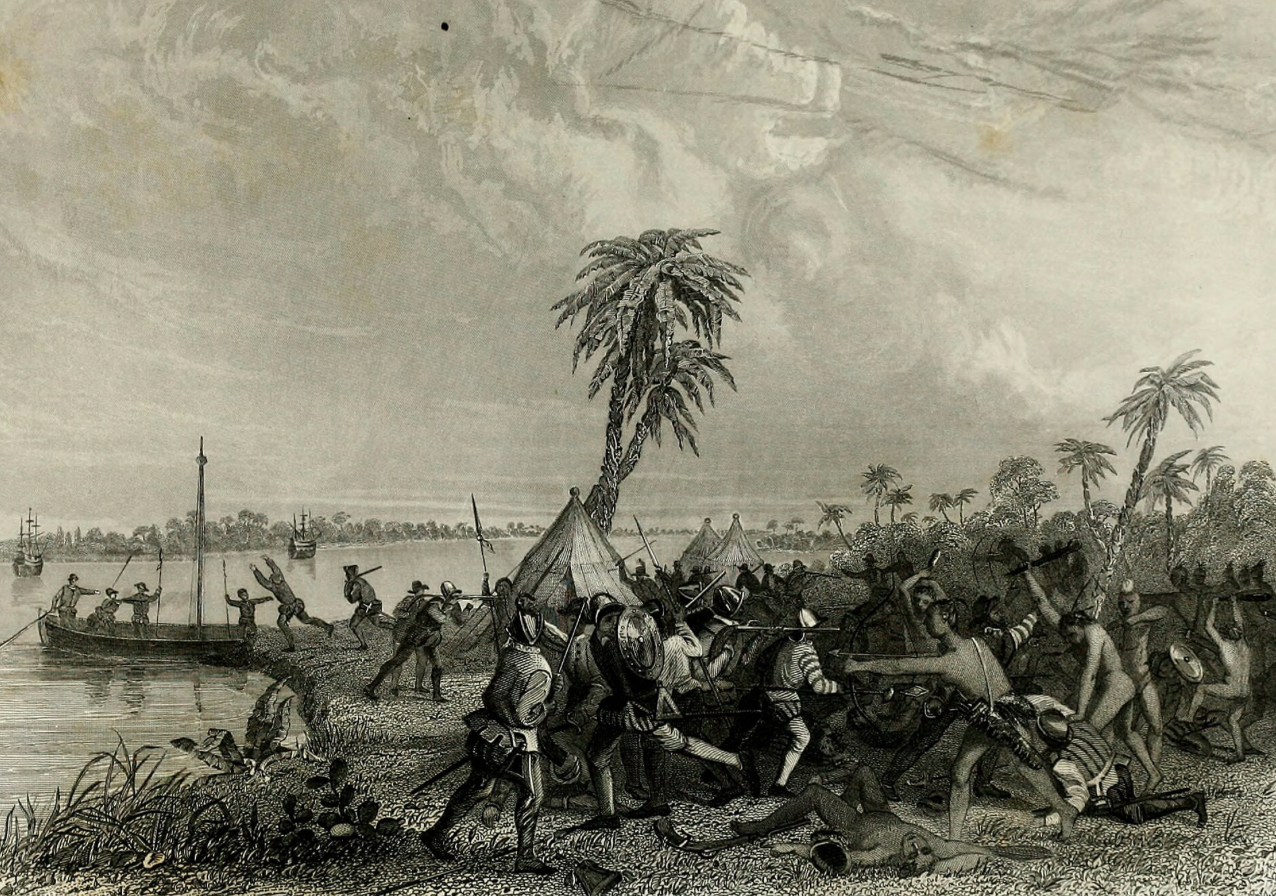
The encomienda system provided the administrative architecture for their exploitation: indigenous people were assigned to Spanish overseers in exchange for the theoretical promise of Christian instruction and protection. On the pearl banks of Cubagua, in practice, it meant that Guaiqueri men were compelled to dive from sunrise to sunset for the profit of men who had arrived on their shores within living memory. Disease, overwork, and violence depleted the Guaiqueri and other indigenous peoples of the Pearl Coast so rapidly that by 1520 a major uprising — led by the indigenous leader of the province of Maracapana, at the head of a coalition of mainland peoples — temporarily expelled the Spanish from Cubagua entirely. The uprising was suppressed. The underlying crisis of labor was not solved by any reform. It was solved by reaching further.
A Civilization Erased: The Taíno and the Speed of Collapse
The scale and speed of indigenous demographic collapse across the broader Caribbean demands to be stated with the precision the evidence supports, because the conventional narrative consistently understates both.
At the time of Columbus's arrival in 1492, the Taíno — the Arawakan-speaking people who inhabited Hispaniola, Cuba, Puerto Rico, the Virgin Islands, and related islands — numbered an estimated 300,000 to 400,000 on Hispaniola alone. By 1507–1508, a census recorded by Las Casas showed approximately 60,000 Taíno remaining on that island. A Spanish count in 1509 found approximately 40,000. Diego Columbus's report of 1510 recorded approximately 33,500. By 1514 — just twenty-two years after Columbus's arrival — the most reliable Spanish census, Rodrigo de Albuquerque's formal distribution, counted 26,334 Taíno. By 1531, the figure had fallen to approximately 600. By 1565, to approximately 200.
A population that may have numbered 300,000 to 400,000 in 1492 was reduced to 26,334 by 1514. The arithmetic of that collapse — roughly ninety to ninety-five percent in twenty-two years — is not a slow decline. It is an extinction event unfolding in real time, driven by disease, forced labor in gold mines, violence, starvation, and the specific brutality of the pearl fisheries.
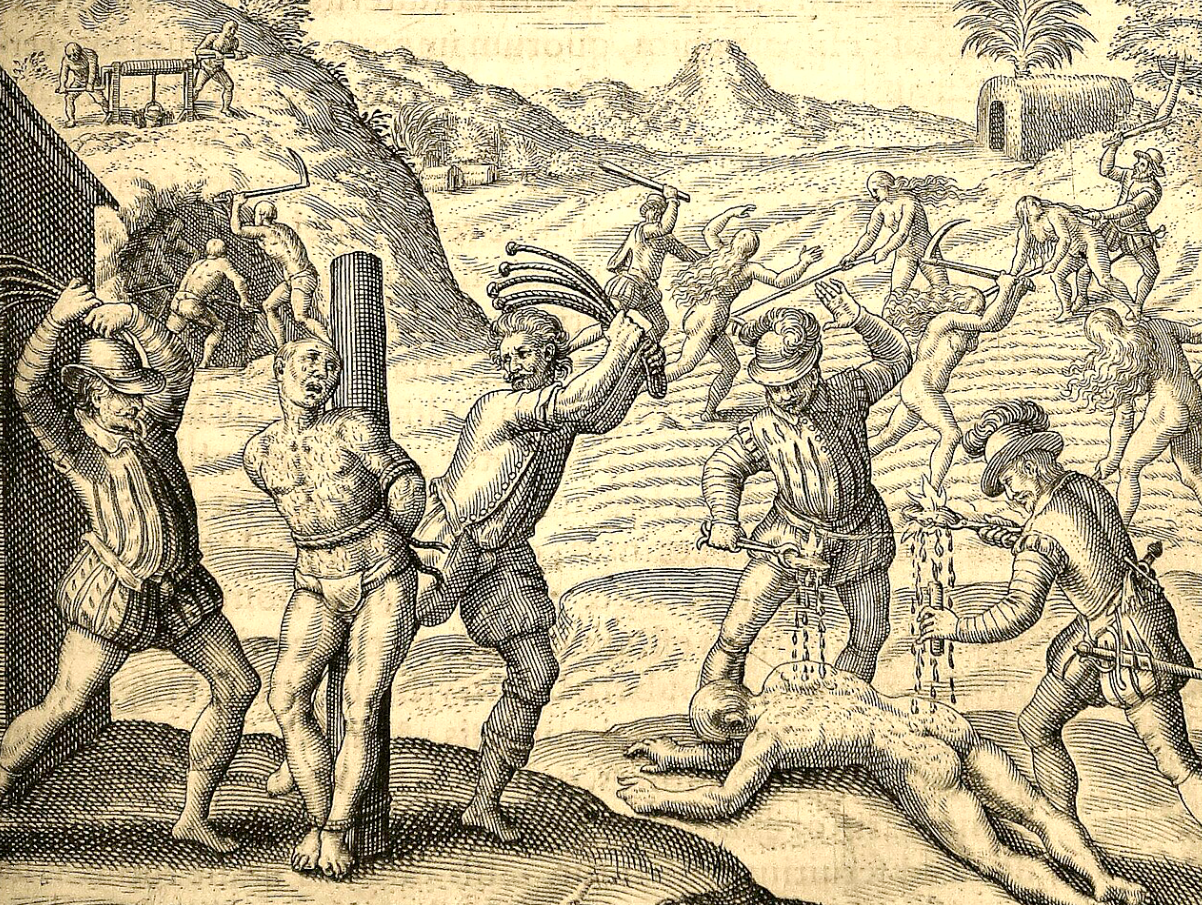
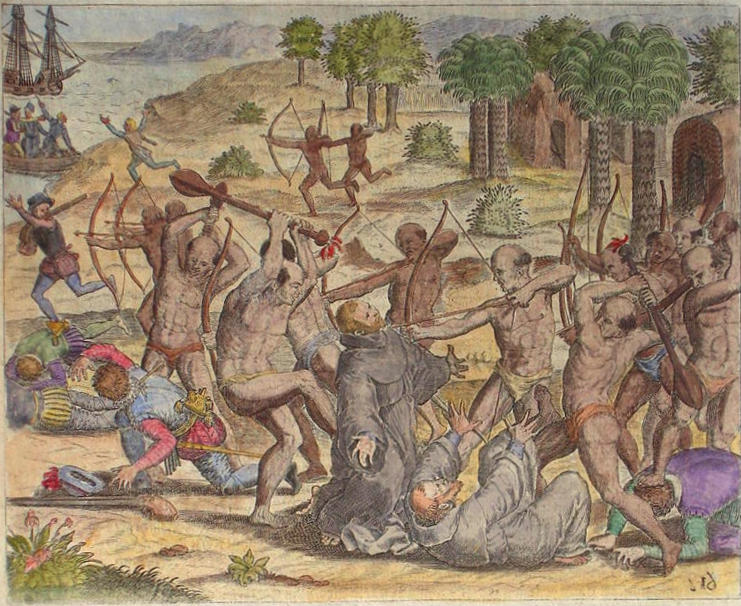
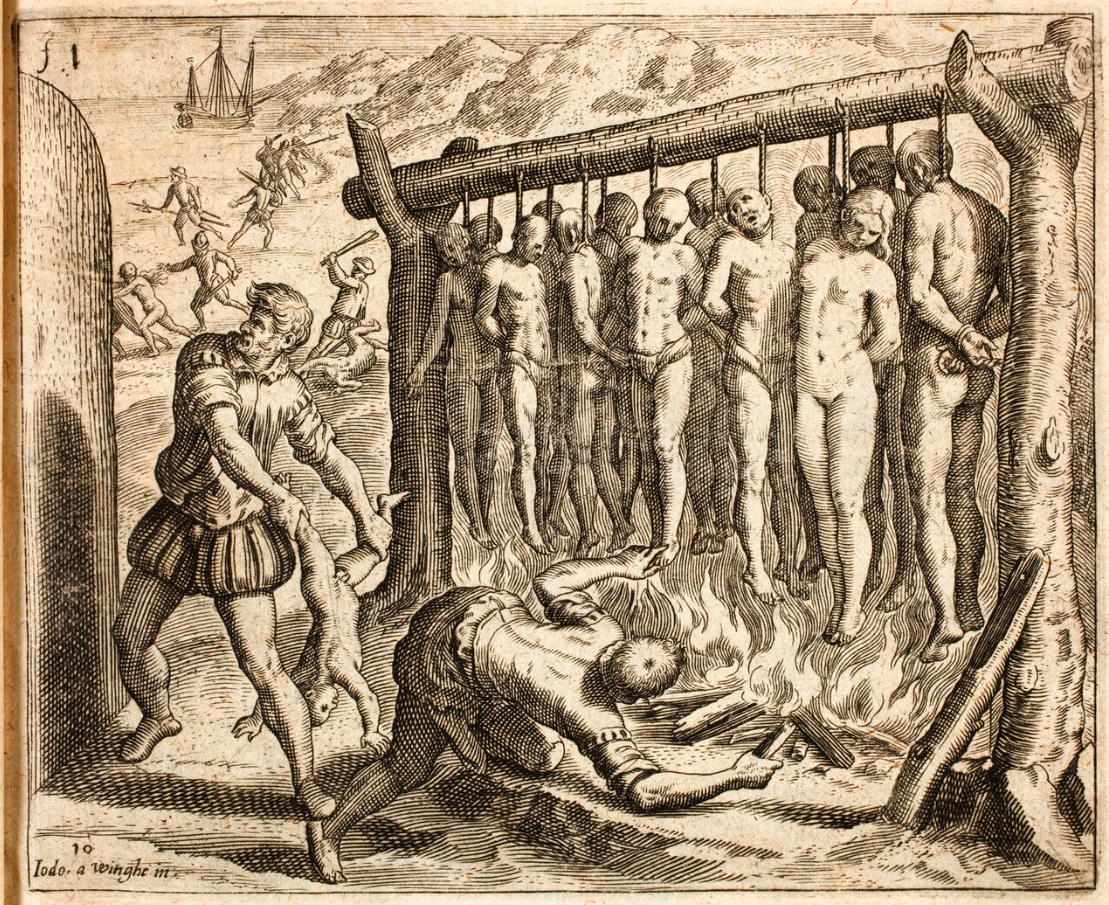
Theodor de Bry illustrates Las Casas extravagant depiction of the Spanish abuses
The Lucayans: A People Gone in Four Years
The Lucayan people of the Bahamas were the first indigenous people Columbus encountered when he made landfall in 1492. They were not combatants. They were fishermen, navigators, and conch divers whose communities stretched across an archipelago they had inhabited for eight hundred years, an estimated 20,000 to 40,000 people living across six hundred islands.
Spain classified the Bahamas as islas inútiles — useless islands — because they contained no gold. For a decade after Columbus's arrival, that classification offered the Lucayans a kind of accidental protection. Then, in 1508–1509, the Spanish discovered that what the Lucayans possessed was not gold but something the pearl fisheries needed even more urgently: an entire people of exceptional swimmers and breath-hold divers, seasoned by generations of harvesting conch from Bahamian seafloors.
Governor Ovando of Hispaniola obtained royal authorization in 1509 to raid the Bahamas for labor. The raids began immediately and proceeded with a thoroughness that the historical record documents in stark numbers. Initially Lucayans sold at 4 gold pesos each on the Hispaniola labor markets. When their diving abilities were recognized and they began being transported directly to Cubagua's pearl beds, the price rose to 100 to 150 castellanos — a twentyfold increase driven entirely by the pearl fisheries' hunger for bodies capable of working underwater.
Las Casas, who witnessed the process and understood precisely what it meant, recorded it with his characteristic combination of precision and anguish: "Los españoles comenzaron a enviar los indios lucayos a coger perlas, porque generalmente son todos grandes nadadores... y era maravilla si, de pocos días, se hallaba un solo lucayo en esta isla Española. Llevábanlos todos allá a Cubagua en navíos. En aquel trabajo tan arduo y pernicioso... los acabaron y consumieron en muy pocos años; y así pereció toda la población de aquellas islas que llamamos los Lucayos."
"The Spanish began to send the Lucayan Indians to gather pearls, because they are in general all great swimmers... and it was a wonder if, within a few days, a single Lucayan could be found on the island of Hispaniola. They carried them all to Cubagua in ships. In that arduous and pernicious work... they finished and consumed them in very few years; and in that way the entire population of those islands that we call the Lucayos perished."
Las Casas's phrase "in very few years" is not literary exaggeration. It is precise contemporary testimony that the evidence confirms. When Juan Ponce de León's three ships sailed through the northern Bahamas in July 1513, searching every island for Lucayan guides who might lead him northward toward Florida, his crew found, across the entire northern archipelago, a single living person: one old woman, alone on a small island. Ponce de León named it La Vieja — the Island of the Old Woman — in her honor. The historian Carl Sauer, reflecting on this expedition, described it simply as "an extension of slave hunting beyond the empty islands." The Bahamas were not being depopulated. They were already empty.
The systematic raids had begun in 1509. By 1513, four years later, the islands were gone. When Spanish authorities made a final attempt to locate and relocate any remaining Lucayans in 1520, they found eleven people in all of the Bahamas. The archipelago then remained uninhabited for one hundred and thirty years.
An entire civilization — eight centuries of maritime culture, six hundred inhabited islands, twenty to forty thousand people — was consumed in approximately four years, primarily to supply divers for the pearl beds of a small island off the coast of Venezuela.
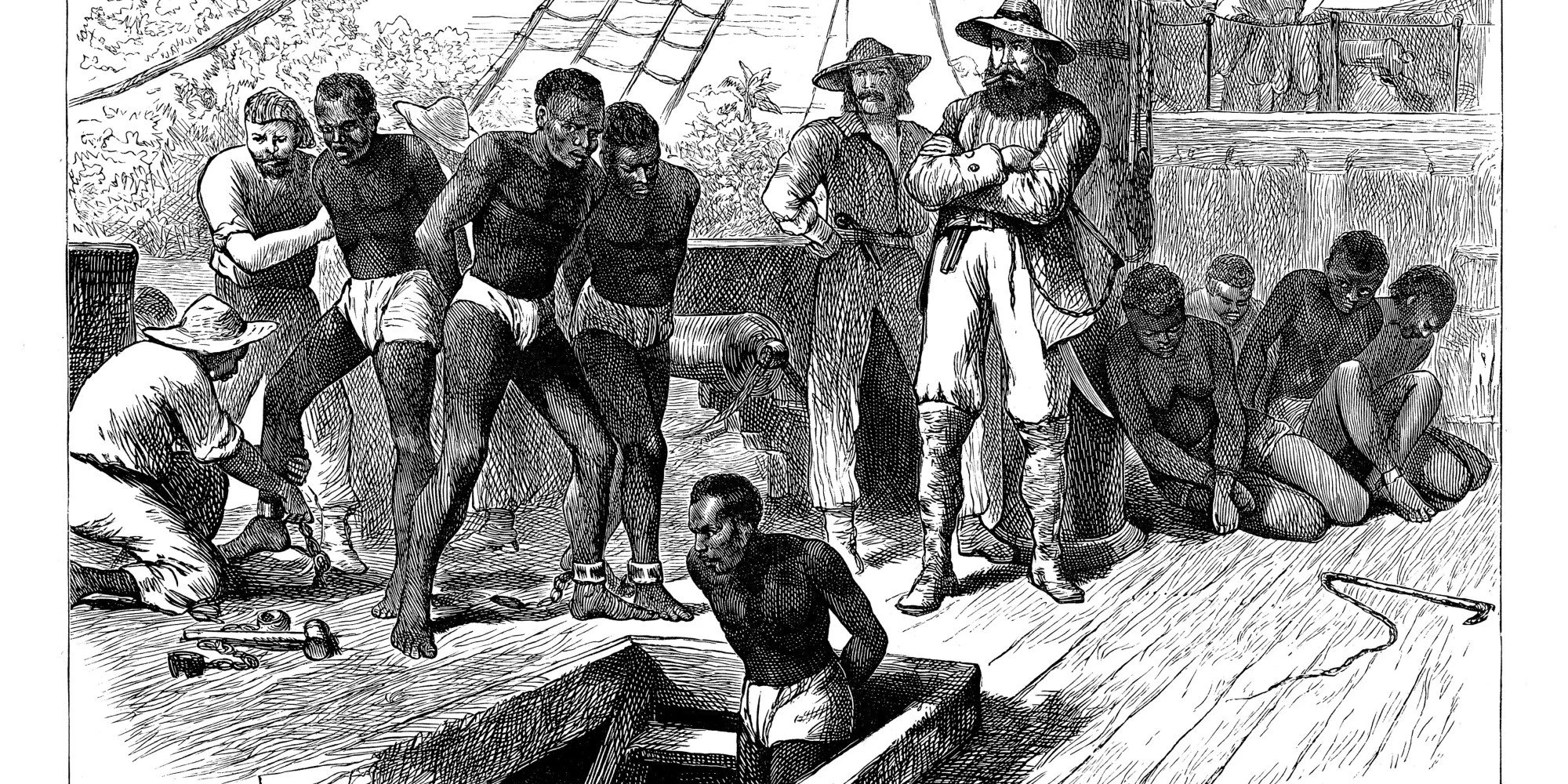
The African Divers: A Three-Stage History
The arrival of enslaved Africans at the pearl fisheries of Cubagua is conventionally dated to 1526, and that date is correct for Cubagua specifically. But to understand what 1526 represents, it must be placed within a broader chronology that begins a full quarter-century earlier — because the organized movement of enslaved Africans across the Atlantic did not begin at Cubagua. Cubagua was where it arrived, not where it started.
The First Stage: Ladinos, 1501–1517
On September 16, 1501, Ferdinand and Isabella signed a royal authorization — the document survives today in the Archivo General de Indias in Seville — permitting ladinos to be sent to Hispaniola: enslaved Africans who had already been living in Spain, already baptized Christians, already Spanish-speaking. These were not men and women seized from African shores and transported directly. They were Africans who had been enslaved in the Iberian Peninsula and were now being transferred to the New World.
The first documented landing of enslaved Africans in the Americas followed in 1502 at Santo Domingo. By 1505, the Crown was sending shipments of seventeen to twenty enslaved Africans to work in Hispaniola's gold mines. By 1510, the first sizable shipment of 250 arrived. For nearly two decades, this ladino system supplied Hispaniola's labor demands as the Taíno population collapsed around it. These Africans were present in the same colonial world where the pearl fisheries were being organized, expanded, and taxed. They were laboring in gold mines on Hispaniola while Lucayan divers were being shipped south to Cubagua's oyster banks.
The Second Stage: Charles V Opens the Direct Trade, 1518
In 1518, Emperor Charles V abolished the ladino restriction entirely. He issued a charter authorizing the purchase of four thousand Africans directly from Portuguese traders at the Cape Verde Islands and their transport to the New World. This was the legal inauguration of the direct transatlantic slave trade — the organized, commercially structured movement of people from African shores to American labor markets that would persist for the next three and a half centuries.
The first slave ships known to have sailed directly from Africa to the Americas departed from Cape Verde and São Tomé in the mid-1520s, arriving in Hispaniola, Puerto Rico, and Cuba. By 1525, direct transport from São Tomé to Hispaniola was underway. By the late 1520s, the system was running at between one thousand and two thousand enslaved Africans arriving in Spanish America per year — a flow that would accelerate throughout the century.
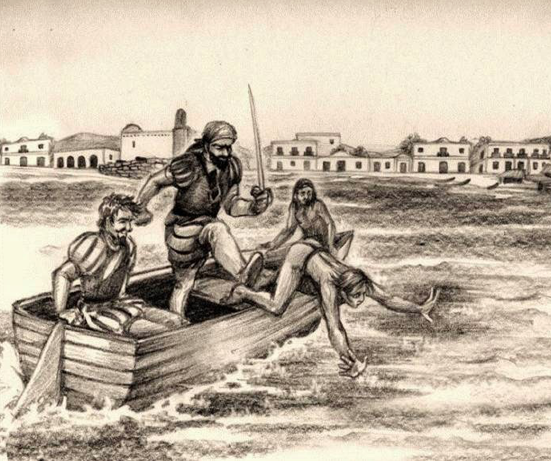
Maria Irene Kiss - Isla Margarita - Pescando Perlas I
The Third Stage: Cubagua, 1526
It was within this already-operating system that the pearl fisheries of Cubagua reached for African labor. By 1526, the Canoe Lords who controlled the pearl operations were facing a labor crisis of their own making: the indigenous populations of the Greater Antilles had been so severely depleted that no further source of Indigenous divers remained within reach. The Lucayans were gone. The Taíno were nearly gone. The Guaiqueri and Pearl Coast peoples had been worked down to a fraction of their earlier numbers.
The solution the pearl merchants reached for was not improvised. It was deliberate, geographically specific, and premised on documented knowledge of African aquatic abilities. From 1526 onward, traders operating out of the Cape Verde Islands were actively purchasing Senegambian and Gold Coast captives selected specifically for work at Cubagua — men chosen because their communities, along the coasts of present-day Senegal, Gambia, Sierra Leone, and Ghana, had produced generations of skilled coastal and deep-water divers.
The first enslaved Africans arrived at Cubagua in 1526–1527. They entered a system that was already, in one generation, consuming its third distinct labor population. The Guaiqueri had been first. The Taíno, the Lucayans, and other indigenous peoples of the wider Caribbean had followed. Now, with the indigenous populations of the entire region effectively exhausted, the pearl fisheries turned to the Atlantic's last available source of skilled divers — and in doing so, connected the pearl beds of Cubagua to the organized transatlantic commerce in human beings that would shape the Americas for the next three hundred years.
Las Casas, who had watched the entire arc from its beginning, reduced it to a single sentence in his Historia de las Indiasthat may be the most economical moral verdict in the literature of the entire colonial period: "No hay vida infernal y desesperada en este siglo que se le pueda comparar" — "There is no life so infernal and desperate in this century that can be compared to it."
He was not speaking of the pearls.
A Friend Named Juanico
Before his testimony can be properly weighed, Bartolomé de Las Casas must be understood not as a symbol of conscience or a weapon in later imperial debates, but as a specific human being whose life had been shaped from childhood by the same forces his writings would one day condemn.
Las Casas was born in Seville in 1484, the son of a merchant family that some biographers believe were conversos — Jews converted to Christianity navigating the dangerous uncertainties of Inquisition-era Spain. His father, Pedro de Las Casas, sailed with Columbus’s second voyage in 1493 aboard the seventeen-ship colonization fleet. Bartolomé was nine years old when his father departed. That same year, on Palm Sunday, March 31, 1493, he stood in the streets of Seville and watched Columbus parade through the city after his first voyage, displaying Caribbean parrots, gold objects, and seven Taíno captives before crowds who had never seen people from the Indies. Decades later, Las Casas recorded the scene in Historia de las Indias with a precision that suggests it never left him.
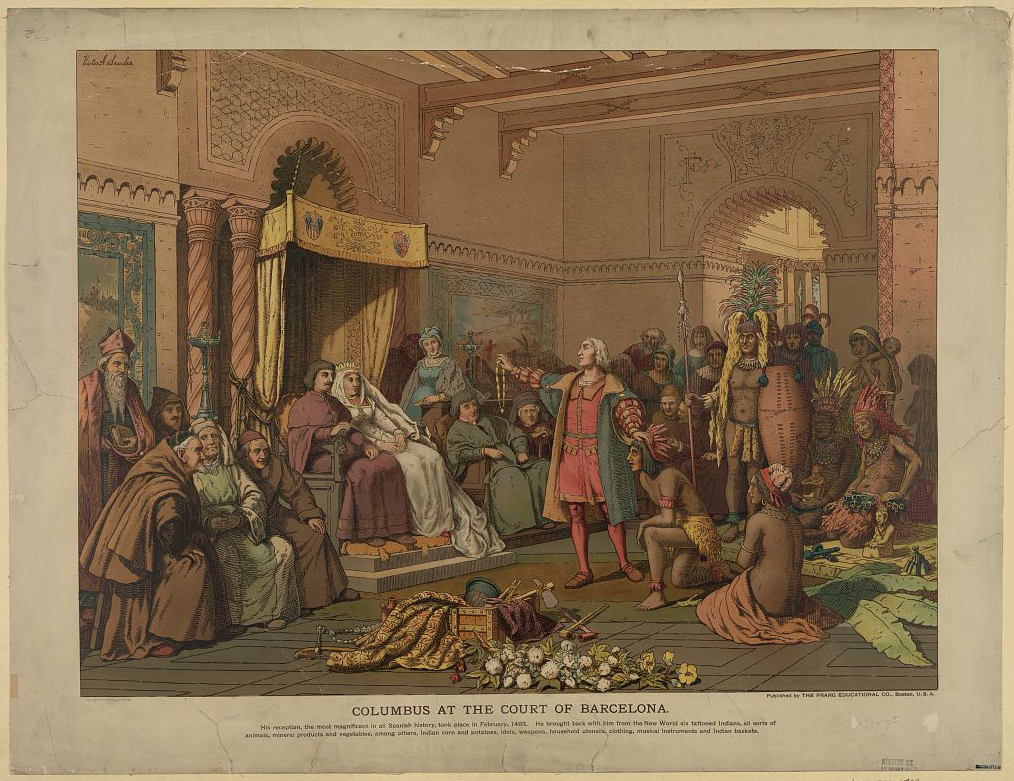
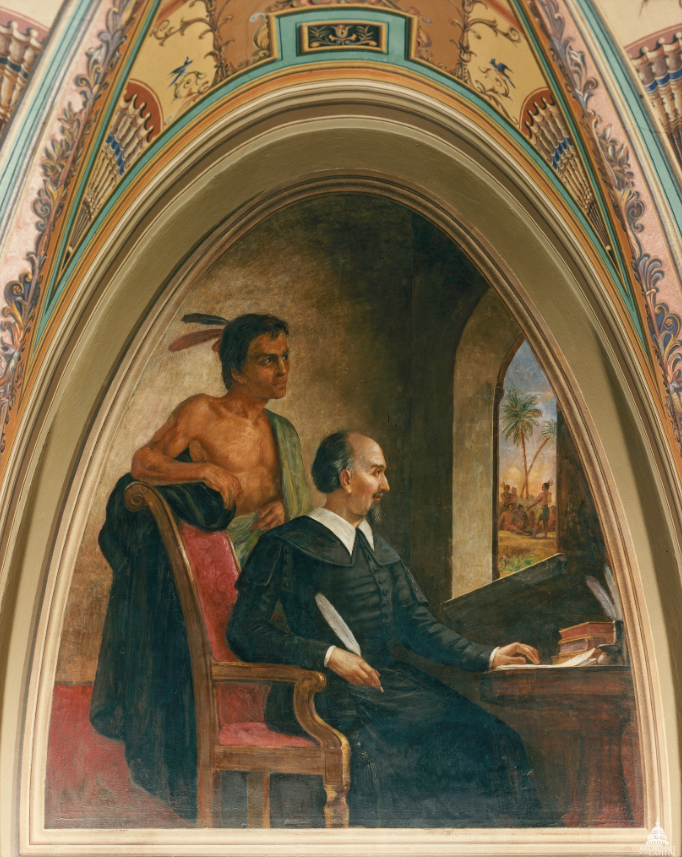
Pedro de Las Casas did not return for nearly five years. When he came back in 1498 or 1499 — at the very moment Columbus was exploring the Pearl Coast and the first pearl cargoes were beginning to reach Spain — he brought with him a Taíno boy named Juanico, presented to Bartolomé as a companion.
Pedro de Las Casas had not acquired Juanico in a moral vacuum. In February 1495 — the same year he returned — Columbus had ordered the seizure of 1,600 Taíno people at La Isabela on Hispaniola, selecting 550 of them, men and women between the ages of twelve and thirty-five, for shipment to Spain. Some 200 died during the crossing — their bodies thrown overboard into the Atlantic — and the survivors arrived in Cádiz on April 7, 1495, consigned to Columbus's business agent for sale in the Seville slave market. When Queen Isabella learned of it, her response was immediate and furious. "By what authority does the Admiral give my vassals to anyone?" she demanded — and issued a public proclamation in both Granada and Seville ordering all those who had brought indigenous people to Castile to return them to Hispaniola on pain of death. Las Casas himself, writing decades later, recorded that his own father was among those commanded to comply. Pedro de Las Casas kept Juanico. Whether through partial enforcement of the royal order, through Juanico's particular status as a personal companion rather than a laborer, or through the creative interpretation of a command that the colonial world was already learning to circumvent, Juanico remained in the Las Casas household. The boy who would become Bartolomé's formative companion had arrived in Seville in the direct aftermath of the most significant moral confrontation the Spanish Crown had yet had with the consequences of its own colonial enterprise — and his presence in the household was itself a small act of defiance against the queen's explicit command.
Bartolomé was fourteen or fifteen. Juanico was likely of similar age.
For several formative years, until Bartolomé sailed for Hispaniola in 1502, the two boys lived together in the Las Casas household in Seville. They shared the same city, the same streets, and daily life in a household connected directly to the New World that had taken Juanico from his home and carried him across the Atlantic as property. Bartolomé studied canon law and prepared for the priesthood while living beside someone Spanish law treated as an object of ownership, but whom he personally knew as a friend.
That fact matters. Las Casas later described the friendship as lifelong. Whatever contradictions marked his later colonial life — including his participation in the very system he would eventually denounce — something from those adolescent years remained intact beneath them. When his conscience finally emerged publicly in 1514, it did not come from nowhere.
Bartolomé de Las Casas - Constantino Brumidi - 1876 - US Capitol
The Port of Pearls and What It Cost the Mainland
By the time Las Casas reached the Venezuelan coast years later, the pearl economy had already transformed the region. The settlement the Spanish called Puerto de las Perlas — the Port of Pearls — existed above all to sustain Cubagua.
The island had no rivers, springs, or fresh water. Every barrel needed by the divers, merchants, overseers, and administrators of Nueva Cádiz had to be ferried roughly twenty kilometers across open water from the mainland. Puerto de las Perlas, later formalized as San Francisco de Cumaná in 1515, became the pearl economy’s lifeline. Without it, Cubagua could not be inhabited. Without Cubagua, there was no Nueva Cádiz, no quinto real, no pearl fleet, and no steady revenue reaching Spain from those fisheries.
The Crown understood the settlement’s strategic value. King Ferdinand ordered construction of the fortification known as Santa Cruz de la Vista to secure the mainland supply route. It became the first permanent Spanish fort on the South American mainland — built not to defend a great city or a silver mine, but to protect the infrastructure of a pearl island.
The coast around Cumaná belonged to the world of the Cumanagoto, a Cariban-speaking agricultural people whose villages occupied the fertile lands near the Manzanares River. In their language, Cumaná referred to the union between the sea and the river. Their communities, often protected by wooden palisades, existed within a wider human landscape that included the Chaima of the interior valleys, the maritime Guaiqueri, and surrounding Carib peoples whose resistance the Spanish both feared and used as a legal pretext for enslavement.
These were not isolated peoples living outside history. They had trade networks, alliances, memories, and political relationships of their own. By the time Las Casas arrived, those memories already included years of slave raids launched from Cubagua onto the mainland to replenish the labor force consumed by the pearl beds.
Las Casas at the Water’s Edge — 1520–1521
Las Casas arrived on the Venezuelan coast in 1520 believing another future remained possible. He had spent years before the Spanish court arguing that peaceful coexistence between Europeans and Indigenous peoples was not only morally necessary, but practically achievable. The encomienda system and the slaving raids, he insisted, were not economic inevitabilities. They were political choices.
Charles V granted him territory near Cumaná where he hoped to build a farming community in cooperation with Dominican friars. European settlers and Indigenous peoples would live alongside one another under Christian protection, proving that justice and royal profit did not have to depend on the violence of the pearl economy.
But the coast he entered had already been poisoned by that economy.
A Franciscan monastery existed at Cumaná and a Dominican mission at Chiribichi, yet both were constantly undermined by Spaniards operating from Cubagua. The friars attempted peaceful conversion while pearl merchants demanded bodies for the oyster beds and treated missionary protection of Indigenous communities as an obstacle to labor extraction. The slavers raided villages, kidnapped local people, traded alcohol for captives, and destroyed the fragile trust the missionaries had tried to build.
To the peoples of the mainland, peaceful settlement and slaving expedition were no longer easy to distinguish. Both arrived from the sea. Both spoke Spanish. Both came from the same colonial world.
The breaking point had come in 1514 with the kidnapping of the baptized cacique of Cumaná, Don Alonso, and his family, who were carried away and sold as slaves in Santo Domingo. The seizure of a Christian Indigenous leader who had accepted Spanish coexistence shattered whatever confidence remained along the coast. From that moment, any Spanish presence, regardless of its stated intentions, could be read as a threat.
Las Casas lived inside the consequences. Through 1520 and 1521 he worked at his settlement while pearl merchants from Cubagua continued undermining it nearby. He was not observing the pearl economy from a distance. He was standing twenty kilometers from the island that sustained it, watching the same system he had denounced destroy the alternative he was trying to build.
In 1521, Las Casas left temporarily to complain formally to the authorities about the interference of the pearl traders. During his absence, violence overtook the region. In the aftermath of retaliatory expeditions led by Gonzalo de Ocampo and years of accumulated provocation, Indigenous communities attacked the settlement, burned it, and killed four of Las Casas’s men. He returned to find his project destroyed.
What the Destruction of Cumaná Proves — and What It Refutes
Las Casas’s enemies seized on the catastrophe immediately. To them, the destruction of the settlement proved that Indigenous peoples could not be peacefully converted and that Spanish force, encomienda labor, and military domination were not choices, but necessities.
Yet the record, read carefully, says something different.
The communities that destroyed the settlement were not rejecting Christianity in the abstract, nor were they attacking the idea of peaceful coexistence itself. They were responding to years of kidnappings, slave raids, forced labor, betrayal, and the seizure of a baptized cacique whose acceptance of Spanish terms had not protected him or his family. Their violence was defensive, political, and historically intelligible.
This is where the later logic of the Black Legend becomes dangerously incomplete if separated from cause and effect. Colonial violence provoked Indigenous resistance, and that resistance was then used to justify more colonial violence. The system created the very conditions it claimed to suppress.
The Cumanagoto did not attack Las Casas simply because he was Spanish. They attacked because, after two decades of devastation, they could no longer afford to distinguish him from the men who had been destroying them. The peaceful settler, the missionary, the slaver, the soldier, and the pearl trader all came from the same sea and served the same Crown.
Devastated, Las Casas entered the Dominican monastery of Santa Cruz in Santo Domingo in 1522 and formally took vows the following year. There he began writing Historia de las Indias.
The pearl economy of Cubagua did not merely provide the background for his testimony. It destroyed the alternative society he had spent years trying to build and helped shape the perspective from which his later writings emerged. Every account Las Casas left concerning the divers, overseers, raids, chains, and fisheries carried the weight of personal experience. He had stood on the mainland shore, looked across twenty kilometers of Caribbean water toward the island responsible, and understood what the Pearl Coast had cost — not as theory, but in the lives of the Cumanagoto, the Chaima, the Guaiqueri, and the men who died in the smoke of a settlement the pearl economy had made impossible.