The Pearl Rush
From the First Profitable Voyage to the Rise and Fall of Nueva Cádiz, 1499–1541
In the spring of 1500, a small caravel entered a harbor in Galicia, on the northwestern coast of Spain, carrying something the Spanish Crown had not yet received from the New World: a profit.
The ship belonged to Pedro Alonso Niño, a veteran navigator who had sailed with Columbus on his first and third voyages. In 1499 he had obtained a royal license to return to the Pearl Coast with a crew of thirty-three men and a singular objective. He found what he was looking for. When his caravel docked, it carried ninety-six pounds of pearls — fine, round, lustrous specimens of five and six carats and more — a cargo so valuable that his own crew immediately accused him of stealing pearls and cheating the Crown of its rightful share. The accusations shadowed his return for years. But history recorded what mattered: Niño's voyage was the first financially profitable expedition to the New World, and within months of his arrival, the harbor at Seville was filling with ships preparing to go back.
The Camps on the Shore
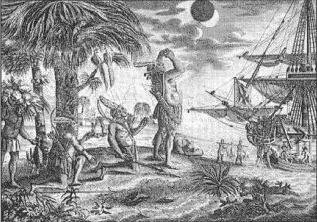
The first Spanish presence on Cubagua looked nothing like a colony. It looked like what it was: an extraction operation.
As early as 1502, archival records describe rancherías being established on the island — seasonal campsites built directly on the oyster banks, occupied during the dry diving months when the water ran clear and the pearl beds were accessible, then partially abandoned when the rains arrived and the Orinoco plume closed the season. There were no stone buildings, no streets, no church, no administrative structure of any kind. There was not even fresh water. Every barrel had to be ferried by boat from the mainland twenty kilometers away, or from Margarita Island three kilometers to the north. Timber did not exist on the island. Food arrived by sea. The logic of these encampments was purely extractive — maximum yield, minimum investment, temporary by design.
Archaeology has since identified thirty-six such settlement sites on Cubagua alone, each positioned in direct proximity to the specific oyster banks the divers were working. A French Franciscan friar, André Thevet, mapped the oyster beds in 1586 and recorded the rancherías clustered around them — a visual document of the spatial relationship between human labor and marine resource that defined the island's entire early history. The settlements were oriented not toward any community life but toward the sea floor below them.
The divers who worked those floors descended to depths of three, four, and five fathoms on a single breath, hauling oysters by hand from the carbonate ledges of the seabed, surfacing with nets full of shells, and descending again from before sunrise until after sunset. Overseers waited in canoes above. The Crown moved swiftly to impose the quinto real— the royal fifth — on all pearls extracted, making Cubagua a direct revenue source for the Spanish treasury from its very first productive season. Every five pearls brought to the surface, one belonged to the king. The books were kept at Hispaniola and then, as operations grew, in the island's own emerging administrative structures.
Between 1500 and 1505, the pearl beds surrounding Cubagua yielded over 2,300 kilograms of pearls — an average, by some estimates, of approximately 1,800 pearls per day reaching the surface. The number is almost impossible to hold in the mind. Each pearl the product of a dive, a breath held in darkness, a hand reaching across the seafloor.
Ruins of Nueva Cadiz
From Encampment to City
Through the second decade of the sixteenth century, the seasonal camps acquired permanence by the sheer weight of commerce flowing through them. Pearl output expanded. Administrative presence deepened. Merchants and traders arrived from Hispaniola, from the Canary Islands, from the ports of Andalucía. By 1515 the settlement had become year-round. By 1520, following a significant indigenous uprising that reshaped the power dynamics on the island, the resident population surpassed three hundred people. A governing council — a cabildo with regidores, aldermen — was established, giving the settlement its first recognizable political structure.
In 1526 the settlement was formally elevated to the status of a villa, briefly designated Santiago de Cubagua, though the title was apparently little used in practice. And then, on September 12, 1528, a Royal Decree issued by Charles V proclaimed the foundation of a city. It was named Nueva Cádiz — after the great Atlantic port of southern Spain from whose harbors so many of its inhabitants had departed. It was the first city in Venezuela, and one of the earliest formally incorporated Spanish cities in all of South America.
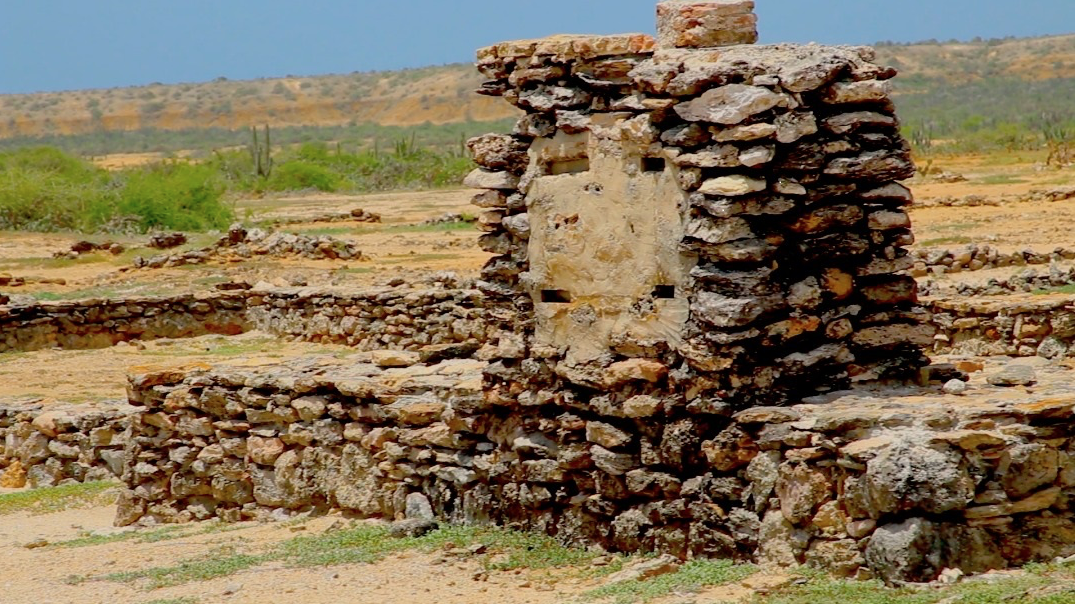
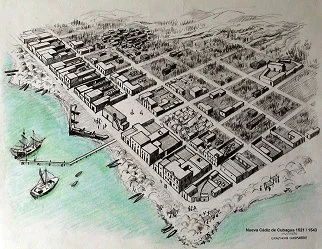
What Charles V's decree created on paper, the people who built it realized in coral stone and salt wind. Archaeological investigations conducted across the twentieth century on Cubagua reveal a surprisingly coherent urban plan beneath the ruins. The city was organized around two principal avenues intersecting at its center, with approximately seven narrower streets forming a modest grid — a compressed echo of the Andalusian urban model transplanted wholesale to a Caribbean island with no soil and no shade. Key buildings, including the church complex and administrative structures, were constructed from coral stone quarried locally and from material ferried from the Araya Peninsula on the mainland. Warehouses and customs buildings clustered at the harbor, oriented entirely toward the sea that sustained the city. Inbound ships arrived carrying wine, oil, flour, livestock, tools, and religious goods. Outbound cargo — carefully entered into royal ledgers — consisted almost entirely of pearls bound for Seville.
By approximately 1530, Nueva Cádiz held between 900 and 1,000 inhabitants: Spanish colonists and merchants, clergy and administrators, Canary Islanders who had crossed the Atlantic specifically for the pearl trade, and a large population of enslaved indigenous laborers from across the Caribbean. The Crown's customs apparatus catalogued pearl shipments with bureaucratic precision — pearls were sorted, categorized by size, shape, and orient, entered into accounting ledgers, and prepared for transoceanic shipment under direct royal supervision. At its peak around 1535, the city's population exceeded 1,500 people. For a small, water-scarce, desert island dependent entirely on imported provisions, this was a demographic concentration of startling intensity — a boomtown built on nothing but the biological wealth of the sea surrounding it.
What Nueva Cádiz Actually Was
To call Nueva Cádiz simply a colonial settlement is to understate what it represented in the architecture of early Spanish imperial finance. It was, in the precise sense of the term, an export city — perhaps the first purpose-built export city in the Atlantic world. Every element of its structure, from the layout of its streets to the placement of its warehouses to the scheduling of its ships, was organized around a single function: extracting pearls from the sea, cataloguing them, taxing them, and moving them to Seville.
The Canoe Lords — señores de canoas — were the economic elite of this system: wealthy merchants and entrepreneurs who owned the canoes, controlled the diving operations, and negotiated directly with the Crown's tax collectors. Their inventories survive in the archival record and reveal operations of considerable scale: individual Canoe Lords owned dozens of enslaved divers, multiple canoes, and supply chains stretching back to Hispaniola and Spain. Below them, royal officials managed the fiscal apparatus — the customs house, the weighing of pearls, the collection of the quinto, the dispatch of the Crown's share to Hispaniola and then to Seville. Pirates and corsairs, whose activity in Caribbean waters was intensifying throughout the 1520s and 1530s, were a persistent threat to the outbound pearl shipments, and their pressure reinforced the Crown's determination to maintain Nueva Cádiz as a formally garrisoned, administratively organized city rather than simply a camp.
The year 1527 was the apex of everything the system could produce. Pearl extraction that year reached 1,170 marks — approximately 1,649 kilograms, or 82,455 carats. To yield that quantity, historians estimate that divers opened at least sixteen million oysters in a single year. Every one of those oysters opened by a human hand, in water, without equipment, on a single breath.
The Depletion
The signs had been present for years before anyone in authority was prepared to act on them. By the late 1520s, divers were already reporting that the beds were thinning — that they needed to go deeper, search farther from shore, open more shells to find the same number of pearls. The quinto real records, analyzed exhaustively by the historian Enrique Otte in his definitive study of the island, show production beginning to fall after 1527 and declining steeply through the early 1530s. By 1531 the first signs of genuine exhaustion were undeniable. The oysters were not recovering between seasons at the rate the operation required. The shallow carbonate banks that had sustained Pinctada imbricata in extraordinary abundance for centuries were being stripped faster than the species could reproduce.
The Spanish response was to expand rather than conserve. New pearl beds had been discovered at Cabo de la Vela on the Guajira Peninsula to the west, in what is now Colombia, and fishing operations began to relocate. The logic of extraction, once begun, admits no other answer. By the late 1530s, production on Cubagua had diminished to a fraction of its peak. By 1539, fewer than fifty people remained on the island. The city that had held 1,500 souls at its height was already, in every practical sense, abandoned.
Then, in 1541, the sea that had made Nueva Cádiz possible delivered its verdict. A hurricane — some accounts suggest accompanied by an earthquake and tsunami — struck the island and destroyed what remained of the settlement. The survivors fled to Margarita. In 1543, French pirates arrived at the ruins and burned what the storm had left standing. By the mid-1540s, Nueva Cádiz had ceased to exist.
The island of Charagato, the Island of Pearls, the city of Nueva Cádiz — forty years of the most intensive marine extraction the Atlantic world had ever seen, and what remained was a flat, windburned limestone shelf and the silence of an empty sea. The ruins of the first city in Venezuela crumbled slowly into the sand, stripped of timber, coral stone, and anything of value by the few who passed through in the years that followed. Along the shore, stretching in mounds where the rancherías had once stood, lay the only monument the pearl economy had left behind on land: mountains of discarded oyster shells, tens of millions of them, bleached white by the Caribbean sun — the accumulated debris of sixteen million oysters opened in a single peak year alone, piled across a landscape that had once been the most commercially productive stretch of coastline in the Atlantic world. The shells outlasted the city. They outlasted the divers who had opened them. They altered the very topography of the island, visible for years afterward as pale ridges rising above the scrub — the physical record of an extraction so total it had changed the earth itself. The ecological balance that Pinctada imbricata had maintained for centuries, feeding on the cold, nutrient-rich upwelling of the Cariaco Basin, had been broken in a single generation.