Indigenous Drilling Techniques
What the Drilled Pearls of Cubagua Reveal About the People Who Made Them
Before a pearl could be worn, it had to be opened.
Not opened in the way an oyster is opened — pried apart to reveal whatever formed within it — but opened by human hands after its discovery. The pearl emerged from the sea already complete, already luminous, requiring nothing from human craftsmanship to create its beauty. What it required instead was something far more delicate: a perforation. A hole small enough to preserve the integrity of the nacre, precise enough to allow a cord to pass through, and achieved without the use of metal tools.
The people of the Pearl Coast had been solving this problem long before Europeans entered the Caribbean. They solved it with patience, observation, and materials drawn from the same marine environment that produced the pearls themselves. The surviving drilled pearls associated with Cubagua still preserve evidence of that craft tradition five centuries later.
That some of these pearls survive at all is a form of historical testimony. That some of them are drilled is a historical argument.
What the Chroniclers Saw
Christopher Columbus did not describe the making of drilled pearls. He described their presence — finished objects already integrated into the adornment traditions of the people he encountered along the Gulf of Paria during his third voyage in 1498.
In the account preserved through Bartolomé de las Casas’s Historia de las Indias, Columbus observed:
“Traían al pescuezo collar de perlas y entre ellas venían algunas muy gordas.”
“They wore around their necks collars of pearls, and among them were some very large ones.”
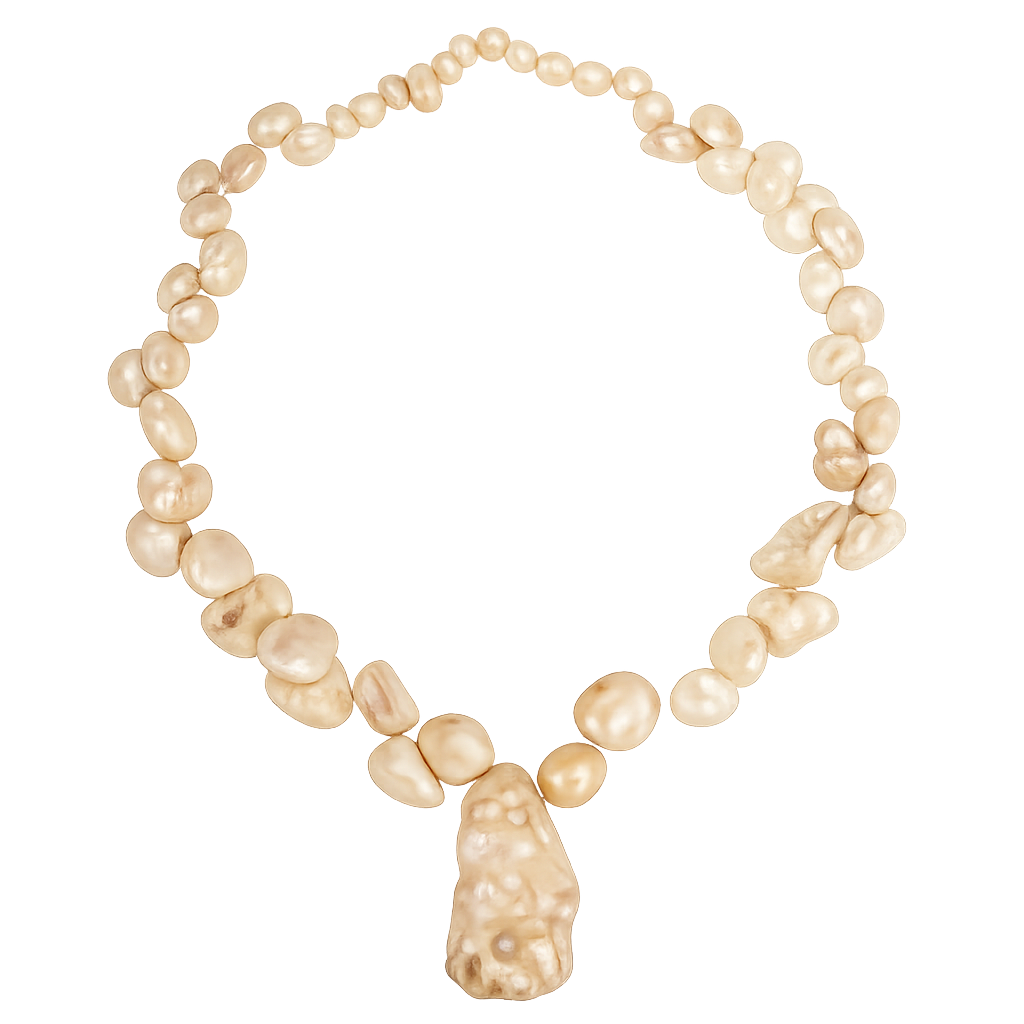
The detail matters. Columbus was not describing loose pearls newly removed from oysters. He was describing completed ornaments: pearls already perforated, already strung, already worn against the body. Their existence implied not merely access to pearl fisheries, but knowledge of selection, preparation, and drilling.
Las Casas expanded the description further. He recorded pearls worn not only around the neck, but also on the arms:
“Traían en los brazos sartales de contezuelas, y entre ellas perlas ó aljófar, finísimas.”
“They wore on their arms strings of small beads, and among them pearls or fine seed pearls.”
The terminology itself is revealing. The word aljófar referred specifically to small pearls of relatively uniform size. Its use suggests categorization rather than random collection. Pearls were being distinguished, selected, and incorporated into ornament according to recognizable standards.
Las Casas also noted something even more technically significant:
“tenían cuatro ó cinco juntas”
“they had four or five joined together.”
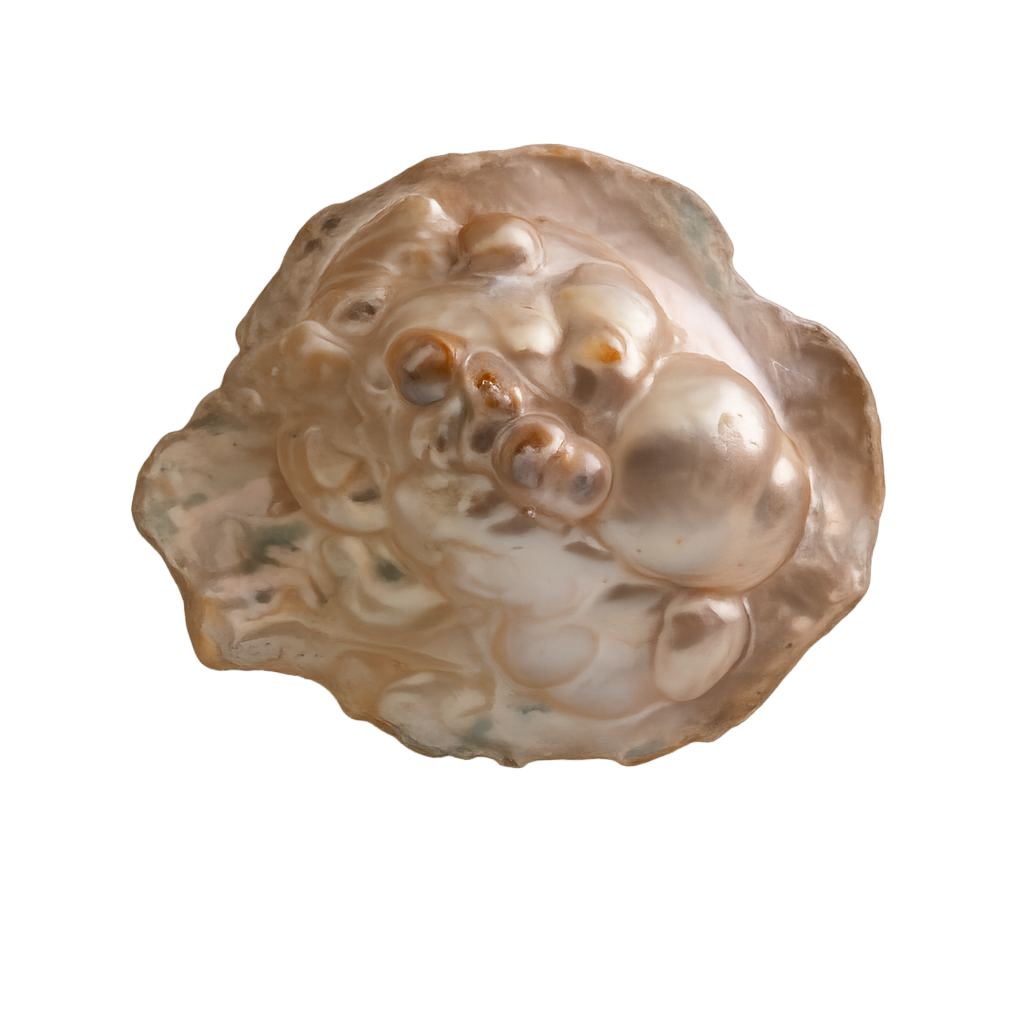
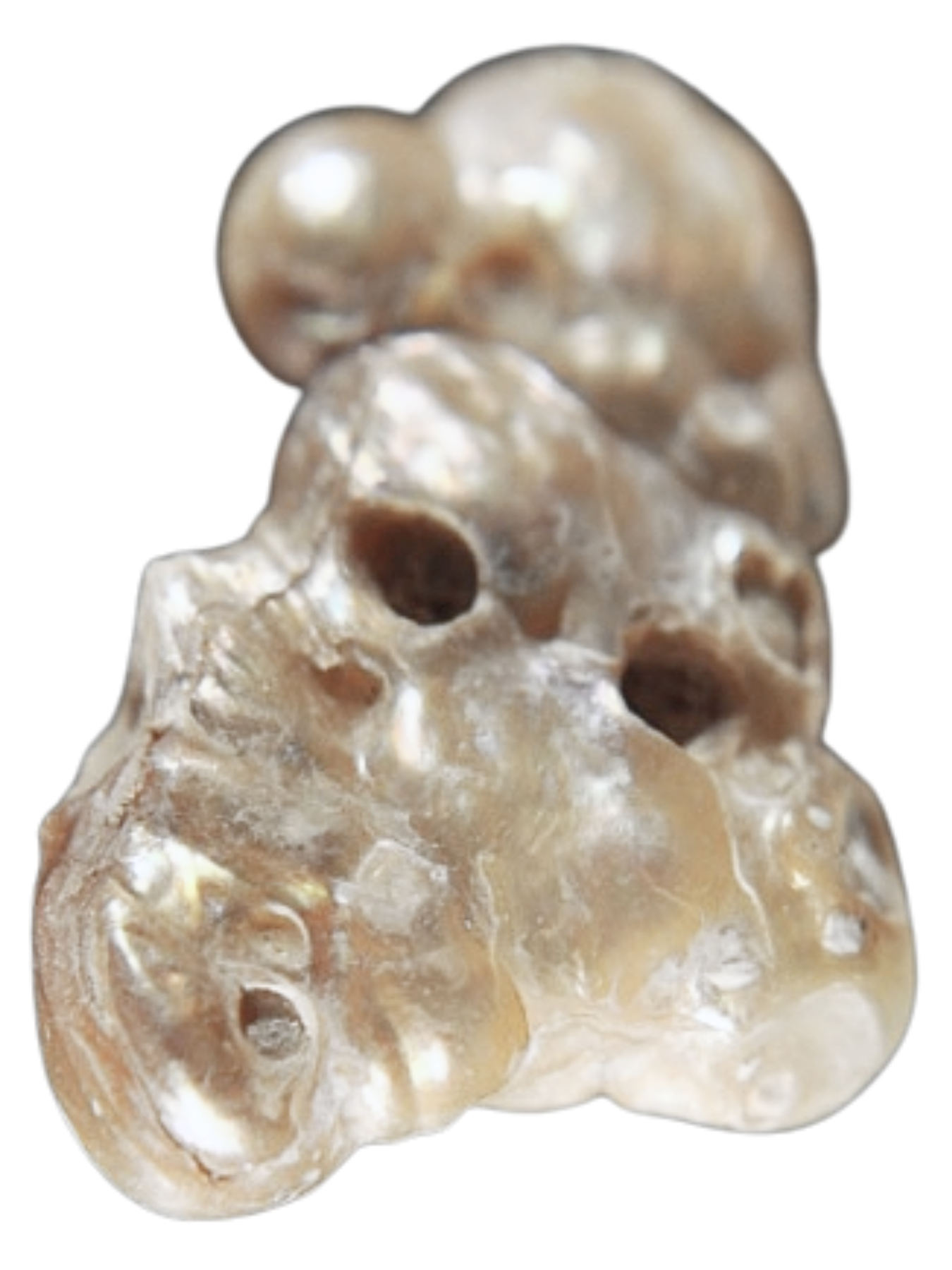
The phrase appears simple, but it almost certainly describes cluster pearls — naturally fused pearl formations in which several pearl bodies develop together inside a single oyster. Such formations are irregular, asymmetrical, and structurally unpredictable. Drilling them requires adaptation rather than standardized technique. Each cluster presents a different problem of balance, thickness, and penetration angle.
Another observer, Peter Martyr d’Anghiera, writing from reports reaching the Spanish court, remarked that some pearls obtained from the region appeared “badly pierced.” From a European perspective accustomed to metal tools and symmetry, the perforations may indeed have seemed crude or irregular. Yet the observation may preserve something far more important than aesthetic criticism: evidence of an entirely different technological tradition.
The holes themselves still remain.
The Nature of Nacre
To understand how these pearls may have been drilled without metal tools, one must first understand what a pearl is made of.
Nacre, the material composing natural pearls, is a biological composite formed primarily from microscopic platelets of aragonite — a crystalline form of calcium carbonate — bound together by an organic protein matrix. Under magnification, nacre resembles a layered architectural structure: mineral platelets arranged in overlapping formations held together by flexible organic material.
The result is remarkably durable. Despite its delicate appearance, nacre resists fracture unusually well for a biological material. At the same time, however, pearl remains relatively soft on the Mohs hardness scale, generally measuring between 2.5 and 3.5. Many naturally occurring materials harder than this — including quartz sand, coral fragments, shell, and shark enameloid — are capable of abrading it.
The challenge in drilling pearl was therefore not simply penetrating the surface. It was preventing the nacre from splitting.
Because nacre forms in layers, poorly controlled pressure can propagate fractures along those microscopic growth planes. A pearl subjected to excessive lateral force may crack or delaminate rather than perforate cleanly. Successful drilling required careful control of pressure, angle, and abrasion over long periods of time.
The drilled pearls associated with Cubagua suggest that such control was achieved with considerable skill.
Reading the Holes
The perforations themselves preserve evidence of technique.
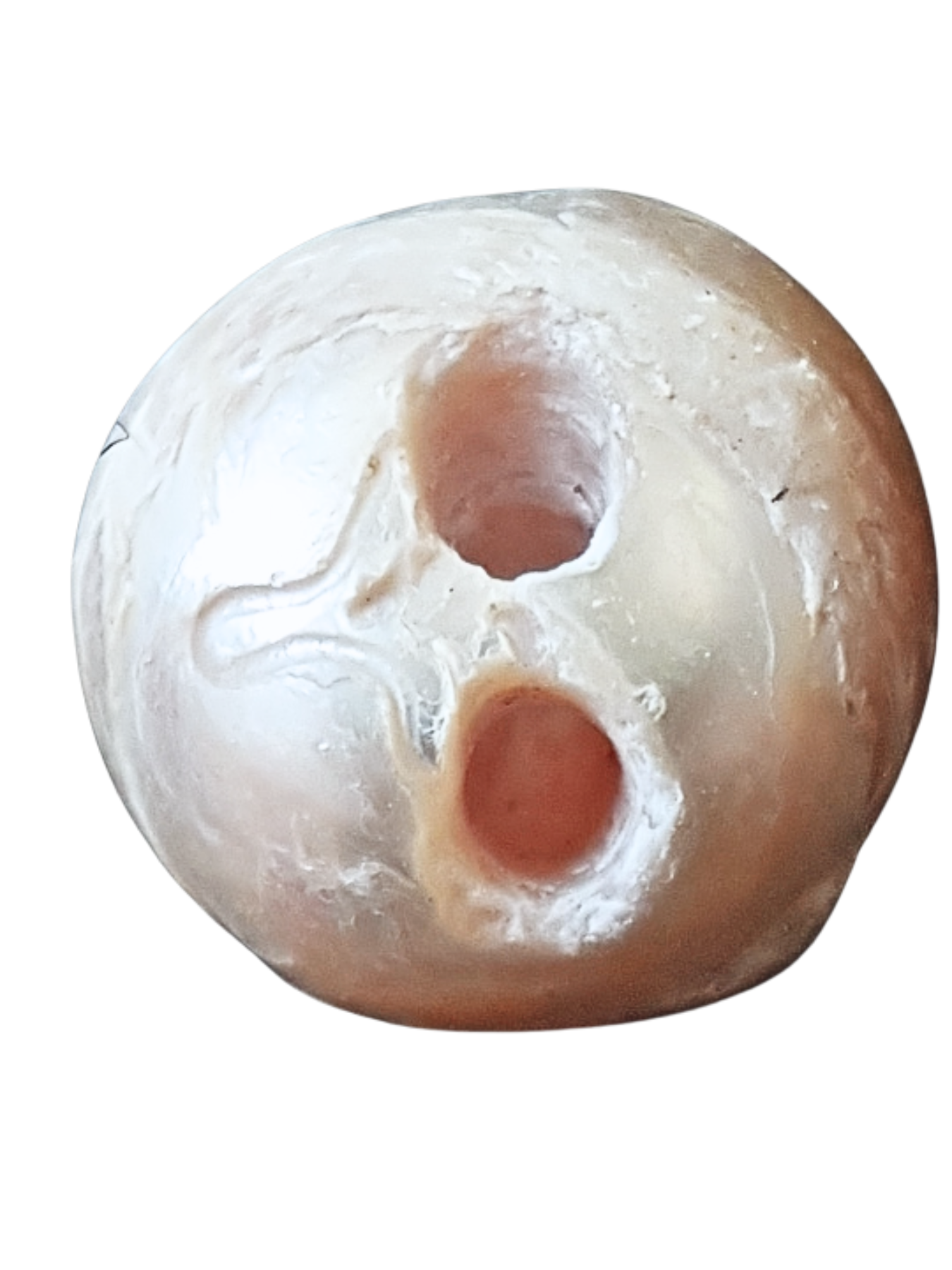
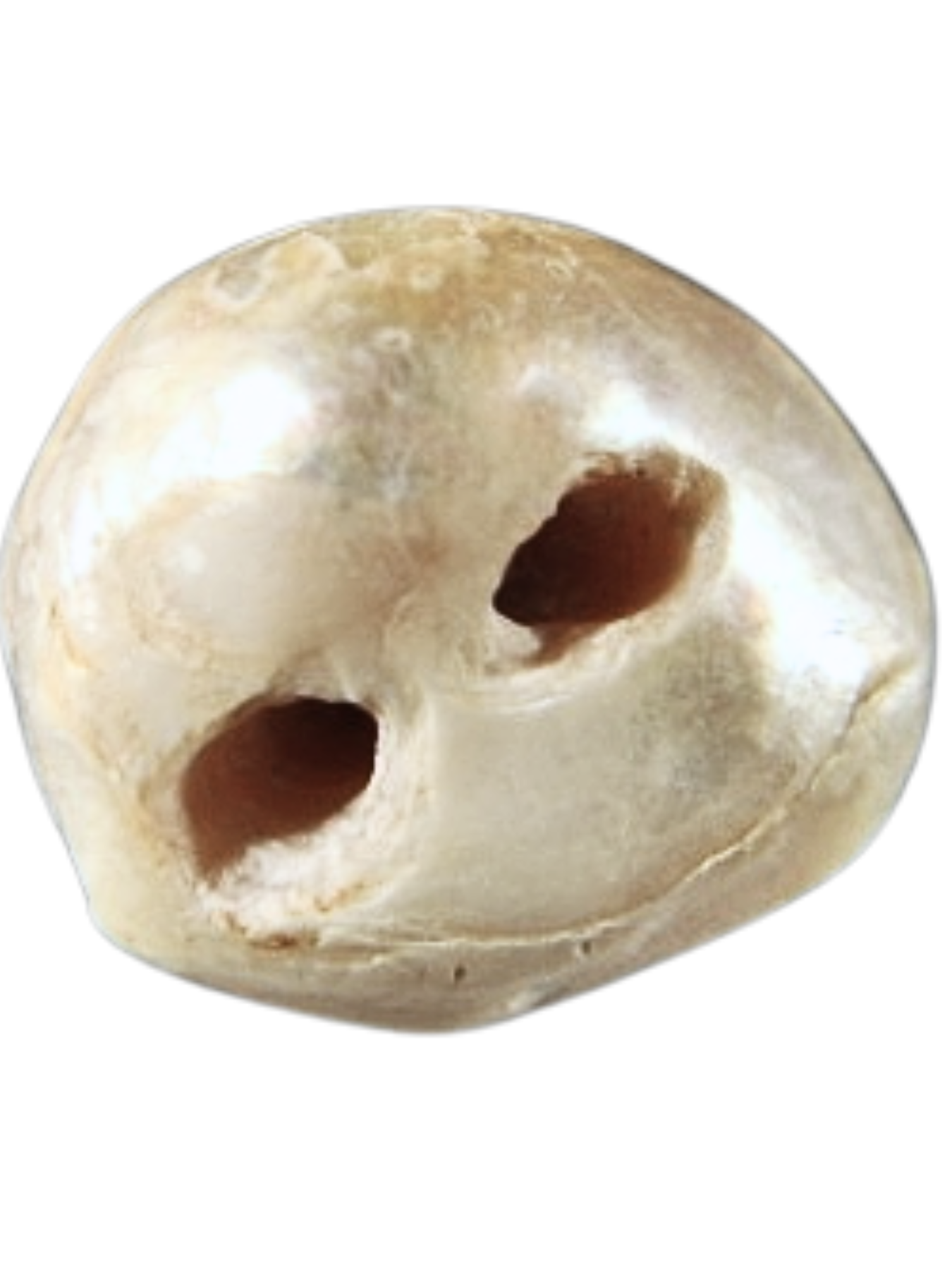
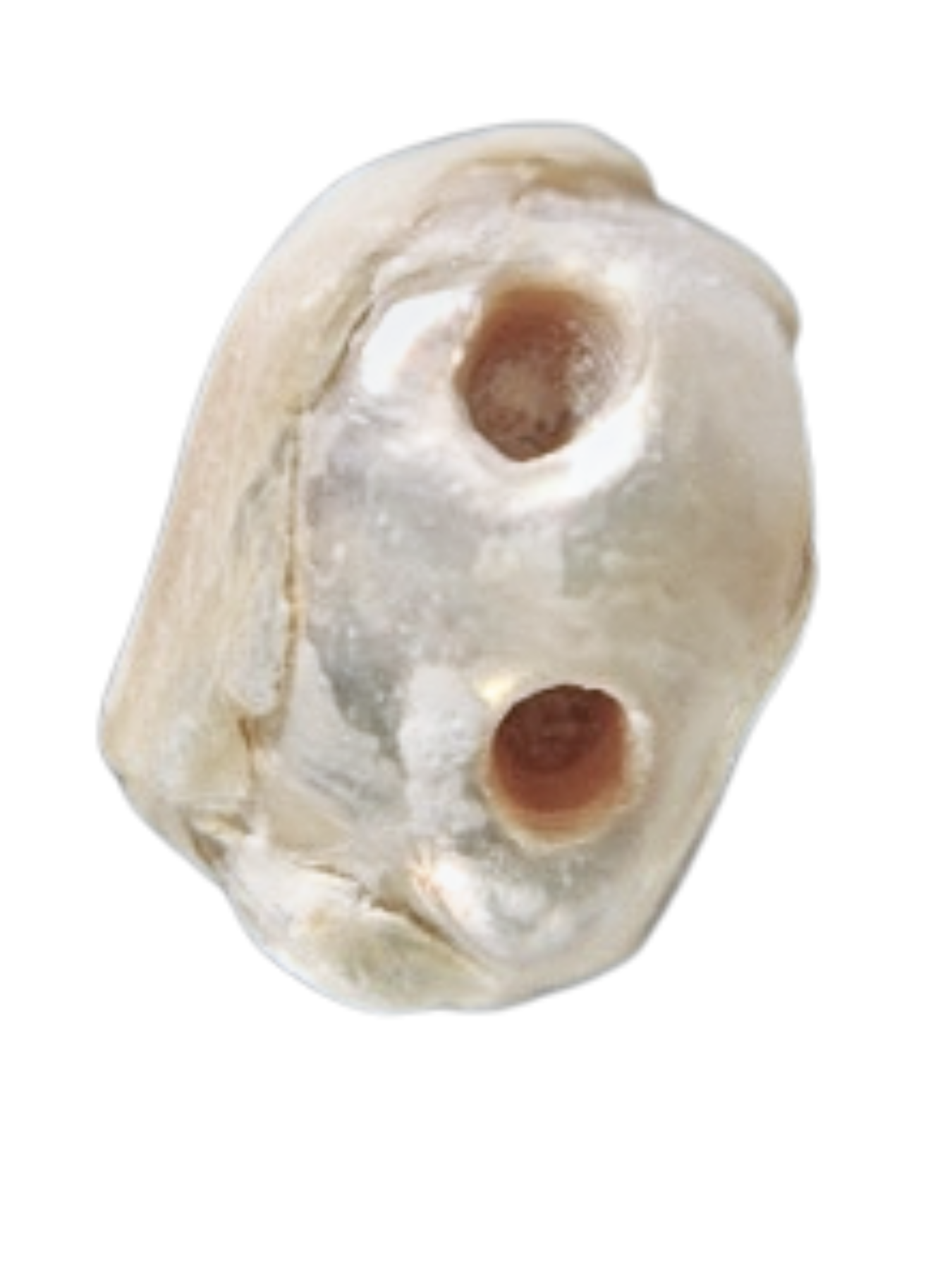
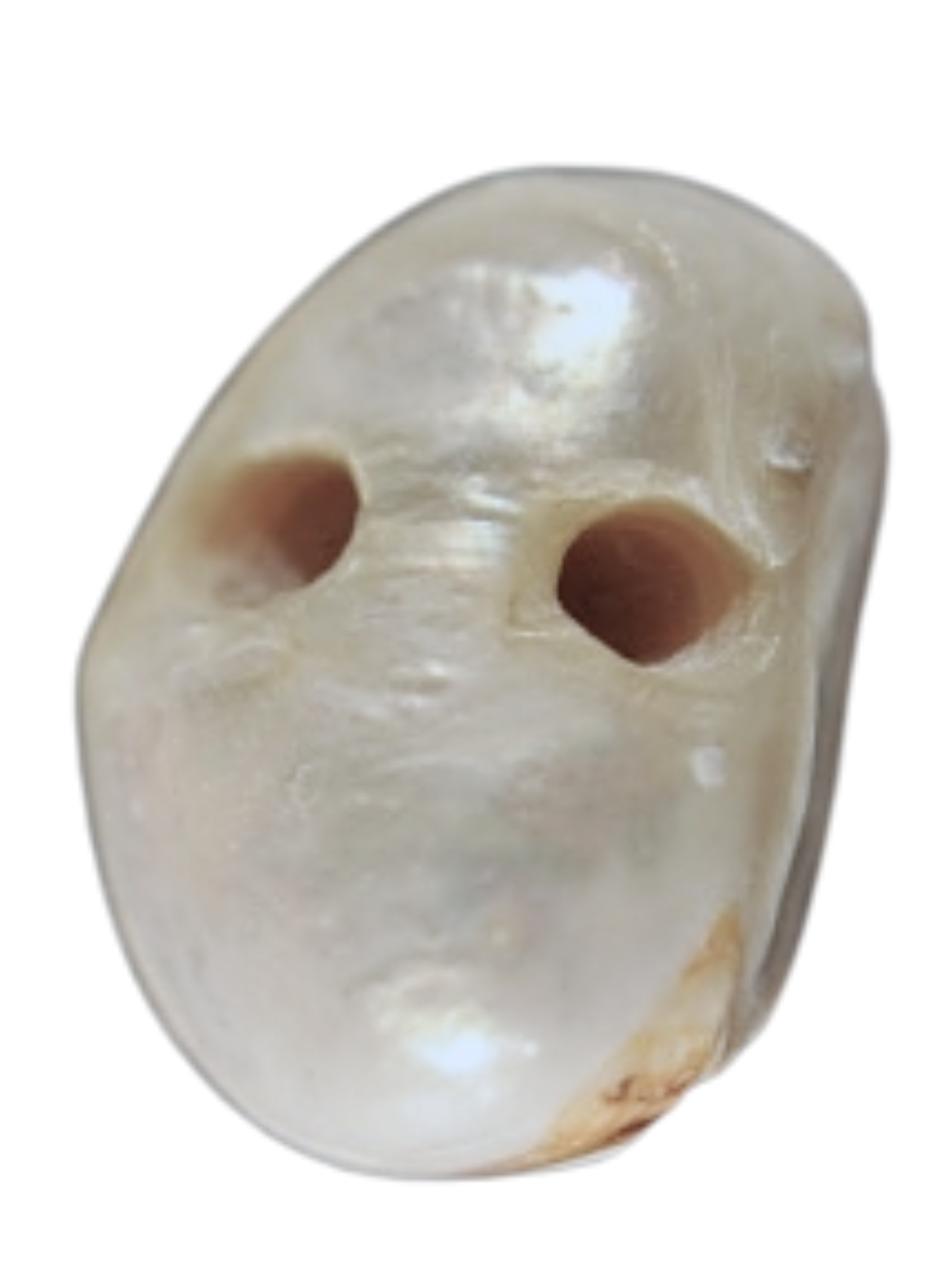
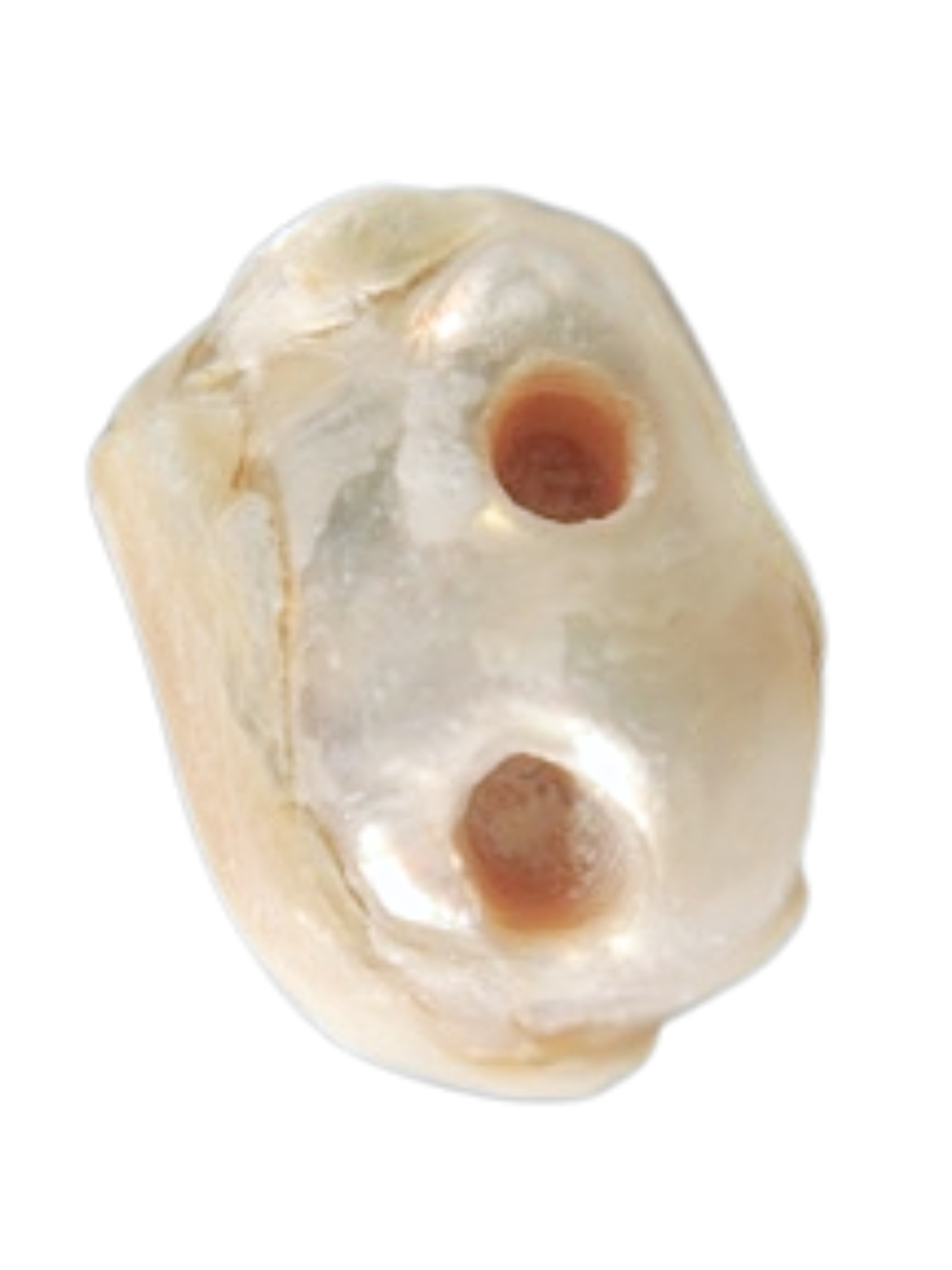
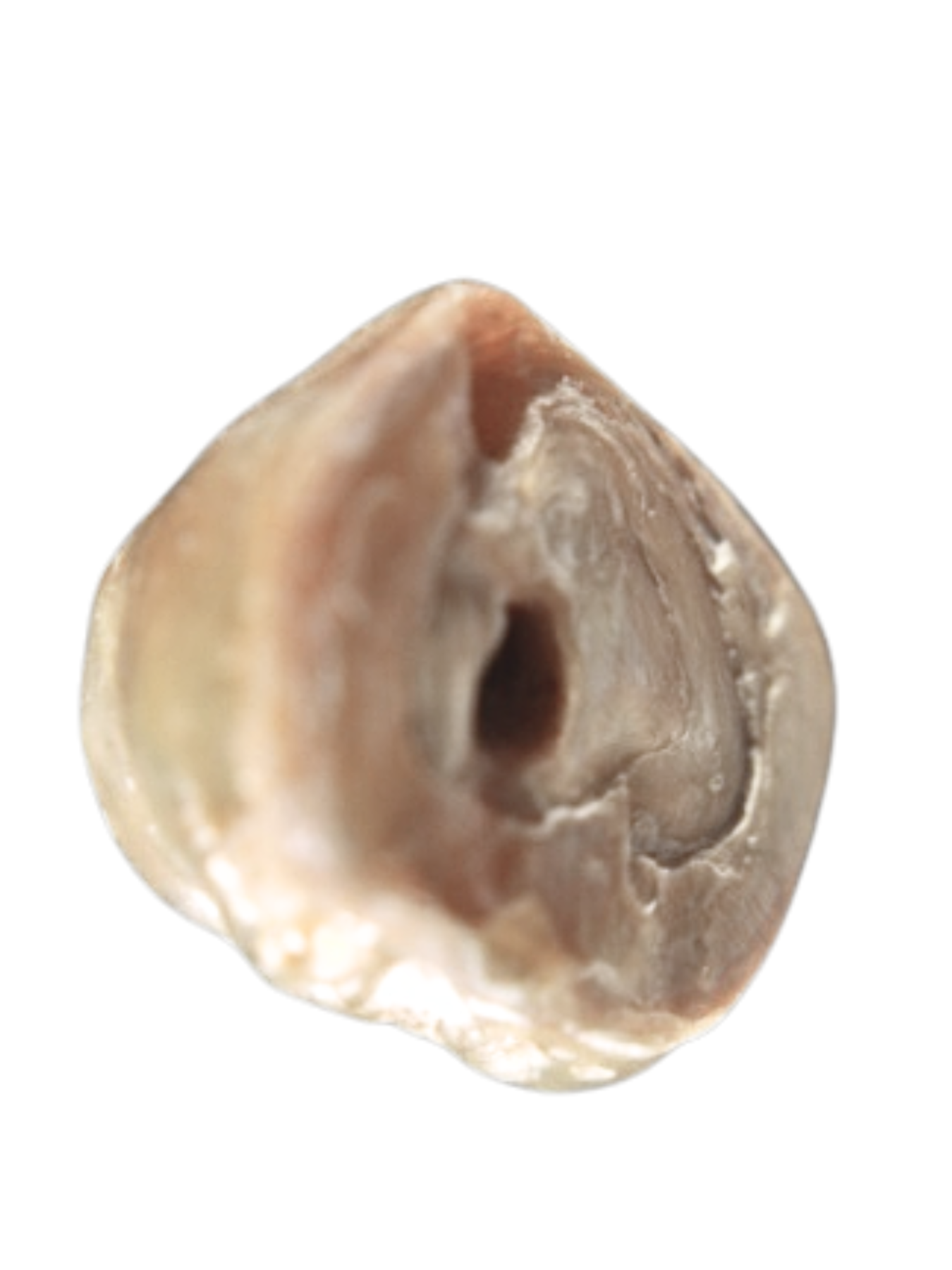
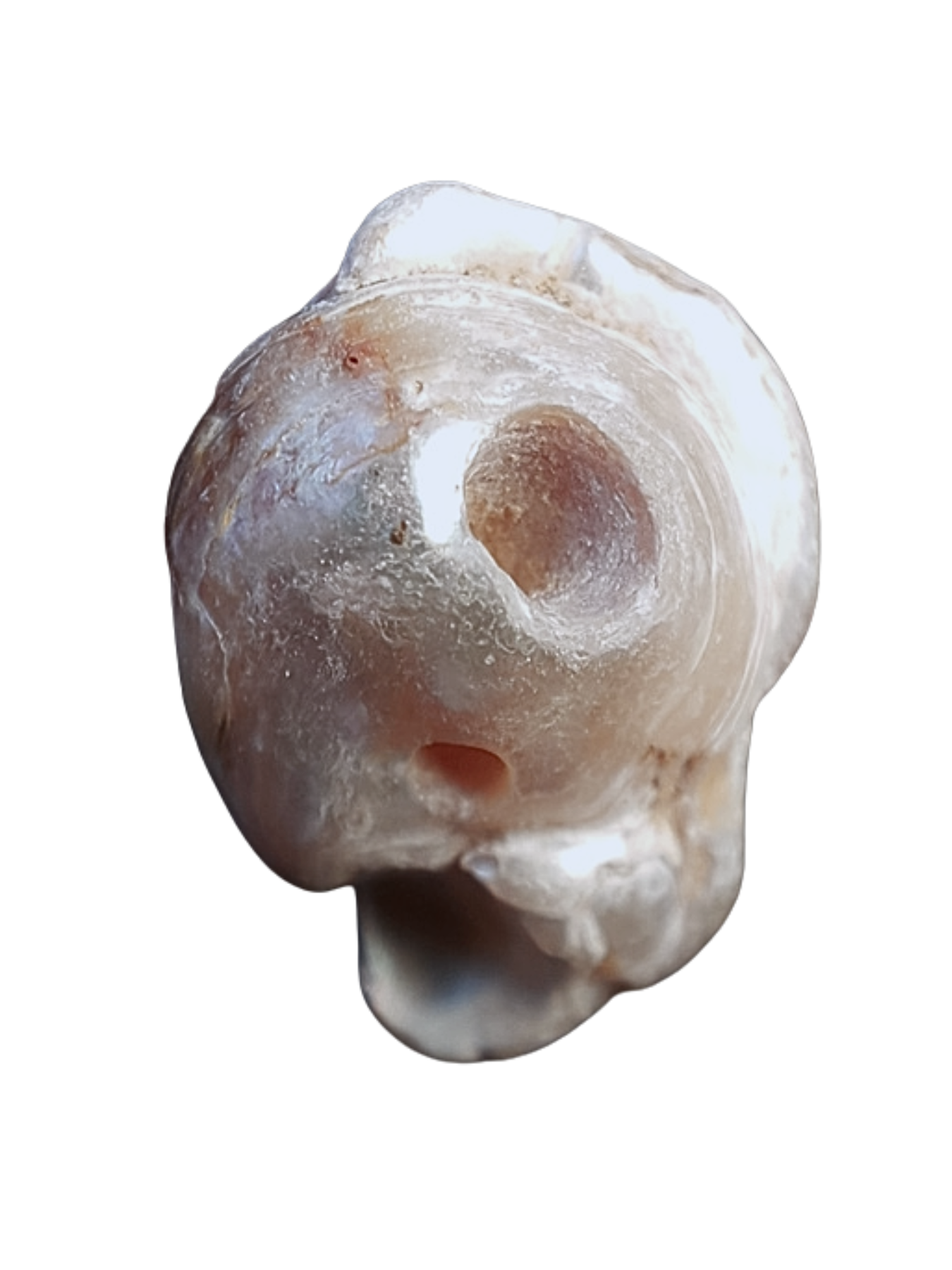
Many of the holes differ noticeably from the cylindrical precision associated with later metal drilling. Entry points are often irregularly positioned rather than perfectly centered along a geometric axis. Some appear slightly tapered or conical internally, widening near the surface before narrowing inward. Others show evidence of redirected penetration or asymmetrical entry angles.
These characteristics may reflect adaptive drilling rather than careless workmanship.
Irregular pearls present irregular structural conditions. A craftsperson working without precision metal instruments would likely have selected drilling points according to the pearl’s morphology — its thickness, balance, surface contours, and stability — rather than according to ideal geometric symmetry. Certain flatter or structurally thinner zones may have offered safer points of entry that reduced the risk of fracture.
The surviving perforations appear consistent with gradual abrasive penetration rather than high-speed cutting. Several holes suggest repeated adjustment during the drilling process, possibly indicating that the operator encountered internal resistance or structural instability and altered the angle accordingly.
The baroque pearls are especially revealing.
Unlike spherical pearls, baroque formations possess highly irregular morphologies: elongated bodies, asymmetrical contours, protrusions, and uneven weight distribution. Their perforations often appear individually adapted to the shape of the pearl itself. In some specimens, the placement of the hole seems designed not merely for penetration, but for orientation — allowing the pearl to hang or rest in a visually stable position when worn.
This is not evidence of mass production. It is evidence of object-specific decision-making.
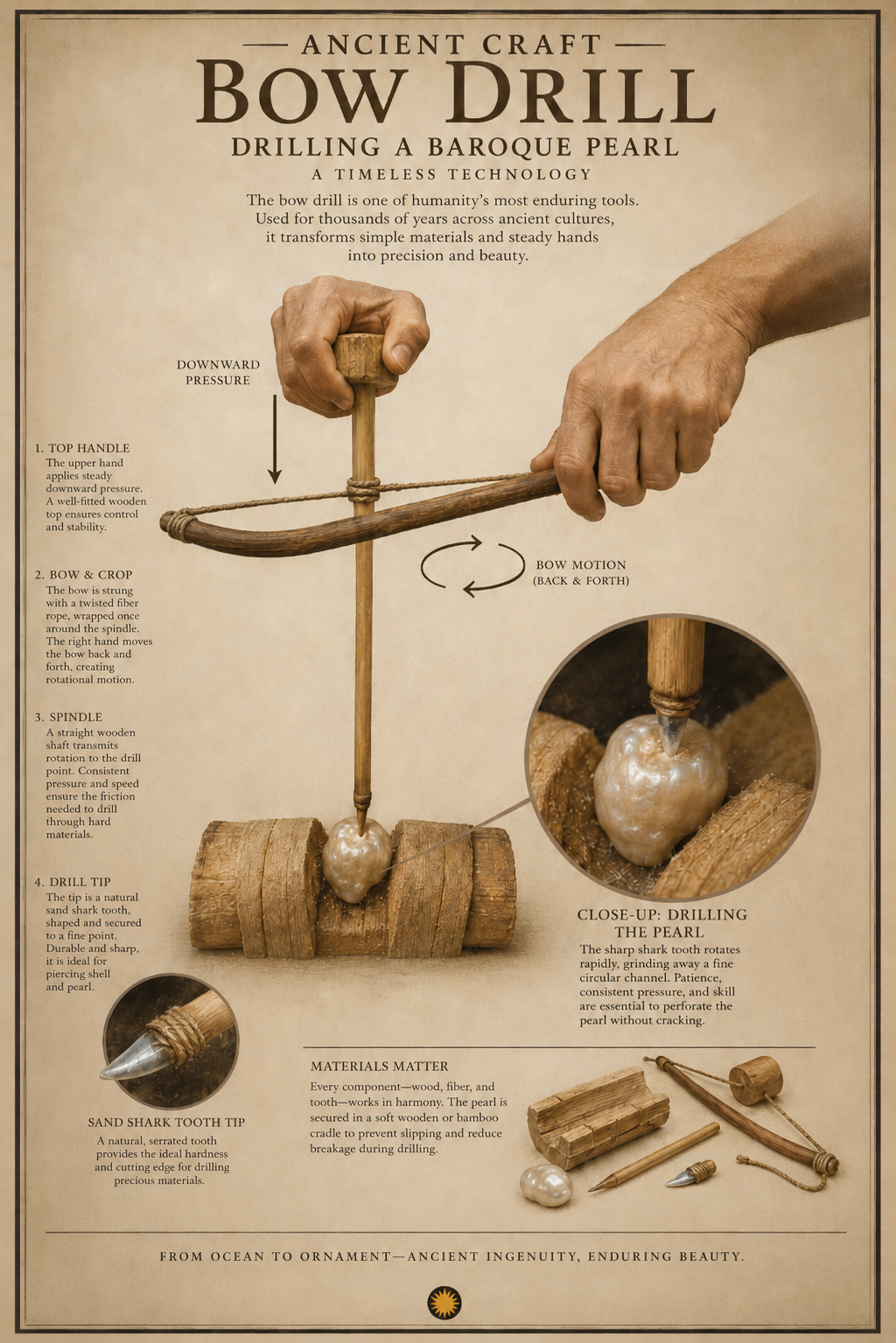
Representation of an ancient bow drill.
Possible Tools and Techniques
No pearl-drilling tools associated directly with the pre-contact fisheries of Cubagua have survived. Organic materials rarely endure in tropical marine environments across centuries. What survives instead are the pearls themselves and the physical characteristics of their perforations.
Among the most plausible drilling technologies is the bow drill, one of the oldest rotary tools in human history and widely documented across multiple ancient cultures. A bow drill converts the back-and-forth motion of a bowstring into rotational movement of a spindle. When combined with abrasive material, such systems are capable of gradually penetrating relatively soft mineral surfaces.
Experimental archaeology and ethnographic parallels suggest that organic points, shell fragments, stone tips, or shark teeth may have functioned as abrasive drilling elements in various pre-metal contexts. Shark teeth are particularly interesting in the Caribbean environment because their enameloid possesses hardness substantially greater than nacre. Mounted onto a rotating spindle and combined with fine carbonate sand or other abrasive particles, such tools could plausibly produce tapered perforations similar to those observed in some specimens.
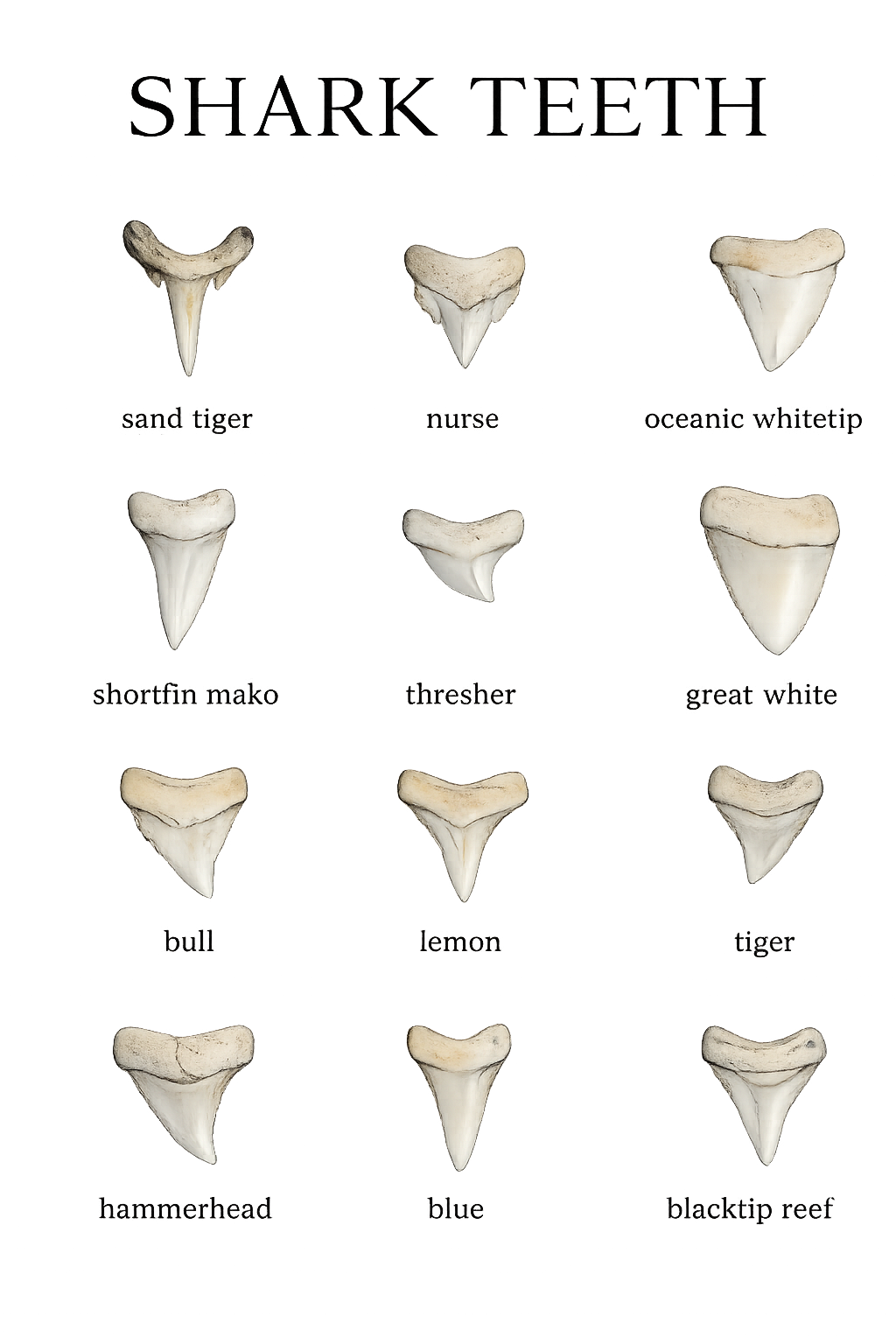
Shark teeth have serrated edges. A sand tiger shark tooth has an adequate shape for drilling.
No surviving text explicitly states that shark teeth were used to drill pearls on the Pearl Coast. The interpretation remains inferential. Yet the morphology of the holes, the physical properties of available materials, and the broader archaeological context remain consistent with some form of abrasive rotary drilling technology.
The irregularity noted by European chroniclers may therefore reflect not technological incapacity, but the signature of a different material tradition altogether.
The Worn Surfaces
Some drilled pearls preserve another category of evidence rarely discussed in historical descriptions: wear patterns associated with prolonged contact against human skin.
On certain specimens, portions of the nacre surface exhibit localized dulling or smoothing distinct from ordinary environmental weathering. Areas once protected retain stronger luster, while exposed contact zones appear softened or matte. Such patterns are consistent with long-term friction against skin, fabric, or repeated bodily movement during use.
Pearls are organic gems and respond sensitively to their environment. Heat, oils, salt, moisture, and friction all affect nacre over time. A pearl worn continuously against the body may accumulate a subtle surface history reflecting years of intimate human contact.
This possibility introduces intriguing scientific questions for future study.
Modern biomolecular techniques continue to evolve rapidly, and researchers have increasingly explored the recovery of microscopic biological residues from archaeological materials once thought incapable of preserving them. Whether ancient pearls retain recoverable organic traces from prolonged skin contact remains uncertain. Yet the possibility itself illustrates how these objects may function not only as gems, but as biological and cultural archives.
The drilled pearls of Cubagua are therefore significant for more than their beauty. They preserve evidence of labor, technological adaptation, bodily use, and human decision-making embedded directly within their surfaces.
Craft Before Commerce
A drilled pearl is more than a pearl with a hole in it.
It is an object that someone selected, handled, assessed, stabilized, and worked upon carefully enough to avoid destroying it. The act required patience, knowledge of material behavior, and familiarity with the structural unpredictability of nacre itself.
That knowledge belonged to people whose names are largely absent from the historical record.
Before the fisheries of Cubagua became integrated into the expanding commercial machinery of the Spanish Empire, pearls existed within Indigenous systems of adornment, exchange, and craftsmanship already centuries old. The people Columbus encountered were not discovering pearls for the first time. They were participating in established traditions of selection, ornamentation, and marine extraction deeply rooted in the waters of the Pearl Coast.
The chronicles preserve fragments of that world. Columbus recorded the necklaces. Las Casas recorded the variety of forms. Peter Martyr recorded the irregular perforations that appeared imperfect to European eyes.
The pearls themselves preserve something more intimate.
A drilled pearl is evidence of time, patience, technical understanding, and repeated practice. Each perforation required controlled pressure, careful positioning, and enough familiarity with nacre to avoid splitting the pearl entirely. The people who performed this work were not improvising. They belonged to a craft tradition refined through experience and likely passed down across generations among the coastal peoples of the Pearl Coast. Long before European merchants transformed pearls into commodities measured by weight and value, skilled hands were already selecting, preparing, drilling, and wearing them in the waters surrounding Cubagua and Paria.