Pearls as Commodity
How Pearls Functioned as Money, Power, and Survival Across the Atlantic World
No commodity in the early Atlantic economy was simultaneously so portable, so concealable, so immediately liquid, and so resistant to imperial control as the pearl. Gold had to be smelted, weighed, and assayed. Silver required minting. Emeralds needed cutting and setting before they could be traded. A pearl of fine quality could be slipped into a sleeve, swallowed, sewn into a seam, or bartered on a beach — and it arrived at the point of exchange already finished, already evaluated by the eye, already carrying its value within itself. Molly Warsh, whose exhaustive study of the Caribbean pearl trade drew on decades of archival research, identified this portability as the defining characteristic that made pearls uniquely dangerous to the imperial system built around them: they were, in her precise formulation, "renewable, fungible, and portable" — and those three qualities together meant that no royal decree, no customs inspection, no quinto real register could ever fully contain them.
The pearl was not merely a luxury commodity. It was a currency — informal, unregulated, and operating simultaneously at every level of the colonial hierarchy, from the Habsburg court in Madrid to the enslaved diver on the seafloor of Cubagua.

At the Top: The Crown and the Court
At the apex of the pearl economy stood the Spanish Crown, which consumed pearls not simply as ornament but as instruments of imperial self-presentation. Charles V, who received more than 150,000 marcos of pearls in quinto real payments across his reign, distributed them strategically among his inner circle as political gifts — a practice that encoded loyalty, hierarchy, and royal favor in a medium that European courts understood instinctively. The pearl was the language of power, and Charles spoke it with deliberate fluency. The Empress Isabel of Portugal, who from 1528 onward managed the Cubagua pearl revenue personally, sent her 1533 order to the island's royal treasurer specifying quality grades with the precision of a jeweler — her eye trained by years of handling the finest specimens the Caribbean had produced. Single pearls of the top grade traded in the markets of European grandees for 30 ducados each — 12,000 maravedís — a figure that places them in an arresting equivalence: one fine pearl was worth, in the slave markets of the period, approximately the price of an enslaved African woman and her child. The comparison is not incidental. It is the arithmetic of the system that produced both.
Pearls funded wars directly. Charles V's Italian campaigns, his competition with Francis I of France, his financing of the tercios — the professional infantry regiments that were the military instrument of Habsburg power — were all sustained in part by the revenues of the Caribbean pearl beds. The pearl, extracted from a waterless island off the coast of Venezuela by an enslaved diver on a single breath, arrived in the treasuries of Europe as the working capital of empire.
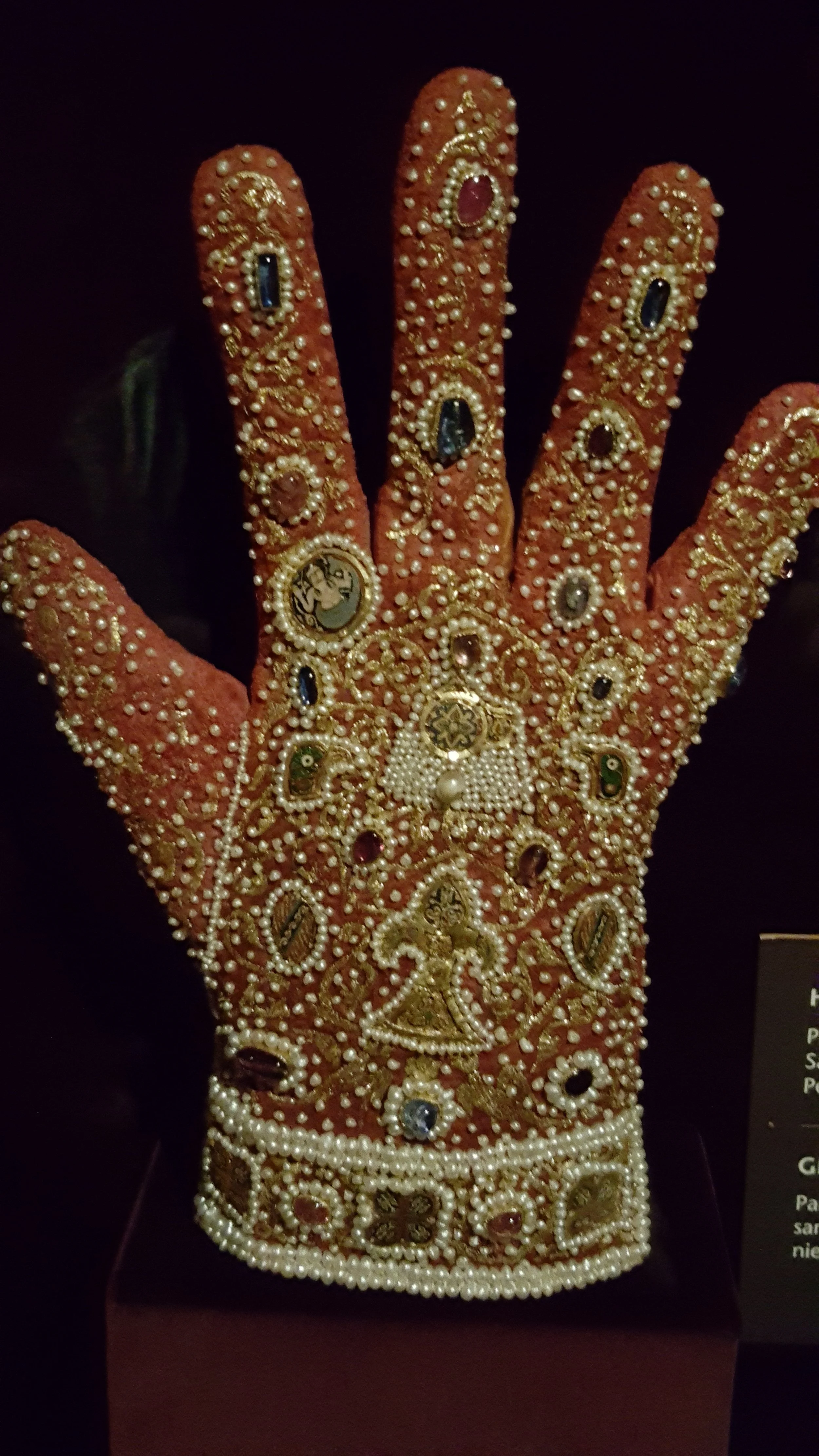
Coronation Glove of Holy Roman Emperor Frederick II - 1220 - Imperial Treasure Chambers of Austria
The Church: God's Share of the Oyster Beds
The Catholic Church was the second great institutional consumer of Caribbean pearls, and it absorbed them with a thoroughness that matched its appetite for all the treasures of the New World. The relationship between the Spanish Crown and the Church was fiscal as much as spiritual — the Church needed the Crown's political protection, and the Crown needed the Church's moral legitimation. Pearls were among the media through which this exchange was conducted.
Ecclesiastical vestments embroidered with pearls — chasubles, copes, mitres, and the elaborate episcopal robes that dressed the hierarchy of the Church in visual declarations of divine majesty — consumed enormous quantities of aljófar and canutillos, the smaller and more elongated pearl classes from the Cubagua classification system. The records of the Seville and Toledo cathedrals from the first half of the sixteenth century document pearl-encrusted altar pieces, reliquaries, and chalices funded directly by Caribbean revenue. A gold plate studded with pearls, donated by the Emperor for use in celebrating Mass, was recorded among the extraordinary riches of one Spanish cathedral treasury of the period. A custodia — the elaborate monstrance used in the celebration of the Feast of Corpus Christi — made for a single major church could consume hundreds of pearls of graduated size, their arrangement by calibre following the same logic as the commercial grading table of the Veedor de Perlas on Cubagua.
The pearl did not arrive in church settings merely as decoration. It arrived as theology. White, luminous, formed without human hands in the darkness of living water, the pearl had been a symbol of purity, of the Virgin, and of the soul since the earliest Christian centuries. When the wealth of Cubagua poured into Seville's workshops and the goldsmiths set those pearls into sacred objects, they were completing a symbolic circuit that connected the sea floor of Venezuela to the altars of Catholic Spain — the most productive marine environment in the Atlantic world becoming, in the hands of a jeweler, a testament to divine grace.
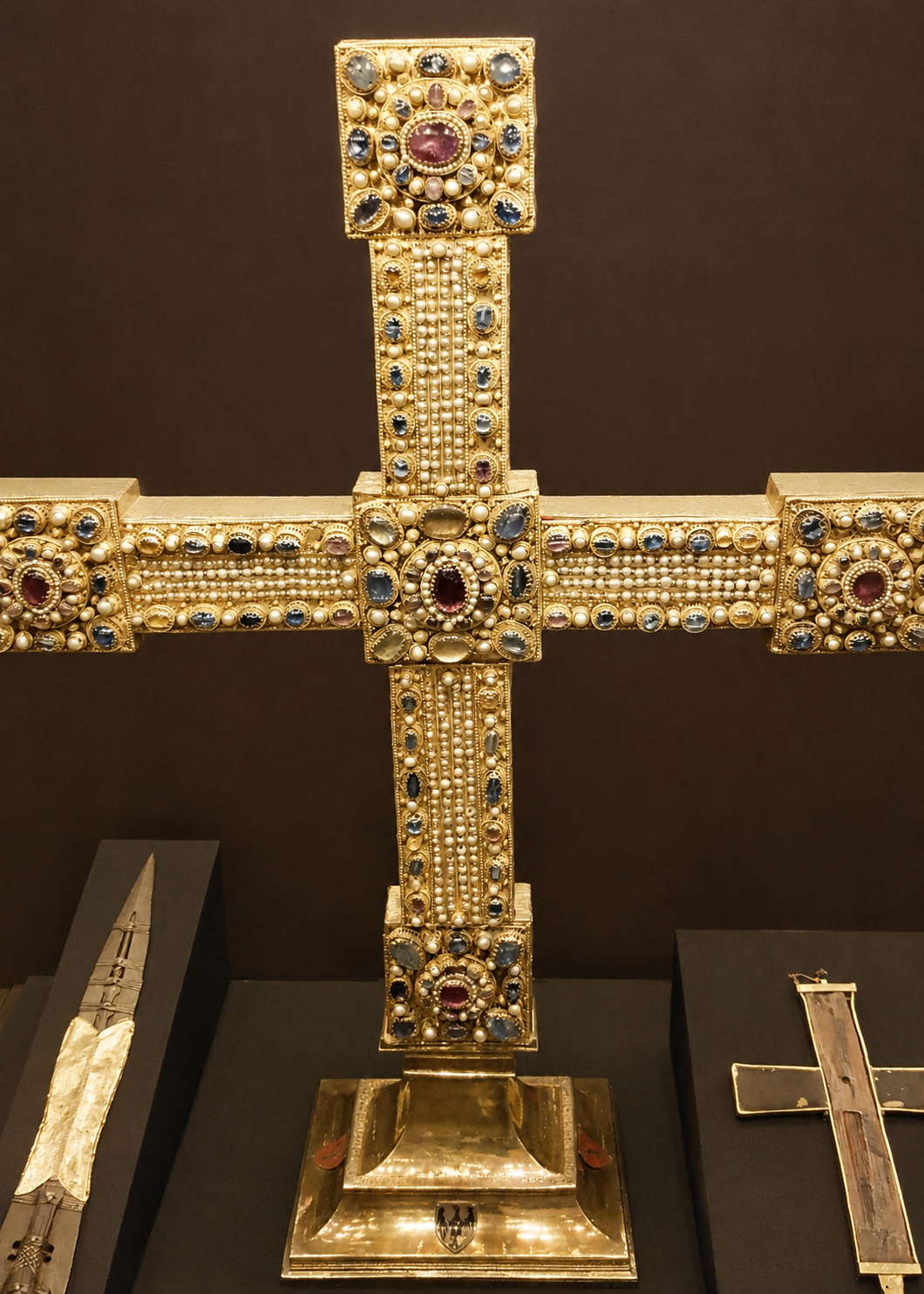
Imperial Cross West Germany - 1030 - Imperial Treasure Chambers of Austria
The Middle Ground: Merchants, Officers, and Professionals
Between the Crown's grand consumption and the enslaved diver's desperate concealment lay a substantial middle tier of the pearl economy — merchants, colonial administrators, military officers, and skilled professionals who received, traded, and used pearls as a functional medium of exchange in an economy where coined money was scarce and unreliable.
At Nueva Cádiz, the shortage of hard currency was a persistent structural problem. The island produced nothing except pearls, and everything it consumed — food, water, timber, tools, livestock, clothing, religious goods — had to be imported. In the absence of sufficient coin, pearls circulated as a local currency. Otte's exhaustive analysis of the Cubagua records documents transactions settled in pearl lots: debts paid, services compensated, and goods purchased with measured quantities of aljófar or perlas menudas that both parties had tacitly agreed to treat as money. The classification system was not incidental to this function. It was essential to it. A transaction settled in pearls required both parties to agree on grade, and the shared vocabulary of redonda, barrueca, oriente, and agua provided the framework within which that agreement could be reached.
Military personnel serving on the Pearl Coast received portions of their compensation in pearls. Officers of higher rank received finer grades — perlas gordas of good oriente — while common soldiers were compensated in aljófar or lower-quality lots. The system was entirely pragmatic: the Crown could not reliably ship coin to a remote island, but pearl revenue was immediately and locally available. The classification system thus became a de facto wage scale, with each grade corresponding to a rank within the military and administrative hierarchy. A captain's pearl payment was not merely larger than a soldier's — it was qualitatively different, drawn from a different tier of the taxonomy that the Veedor had established at the weighing table.
The Bottom: Pearls as Survival
At the lowest level of the system — among the enslaved divers who produced everything and owned nothing — the pearl functioned in a way that no royal decree anticipated and no quinto real register recorded: as the only available instrument of self-liberation.
Enslaved divers on Cubagua had no legal right to any pearl they retrieved. Every oyster they opened, every pearl their hands brought to the surface, belonged to their owner or to the Crown. And yet some pearls disappeared between the seafloor and the canoe. Warsh, drawing on Otte's archival research, documented a practice that the colonial record acknowledged with a mixture of outrage and resigned acceptance: enslaved divers swallowed pearls — concealing them within their own bodies, retrieving them afterward — and accumulated, over months or years of this hidden practice, enough value to purchase their own freedom. The pearl that could buy an enslaved woman and her child could also, in sufficient quantity and over sufficient time, buy the freedom of the person who had retrieved it from the dark.
This was not theft in any moral sense the divers would have recognized. It was the most basic possible assertion of human agency within a system designed to deny it entirely. And it worked. The colonial records contain documented cases of enslaved divers who purchased their own manumission — freedom granted in exchange for accumulated pearl payments. The pearl that had been extracted to finance the tercios of Charles V was also, in the hands of the people who had paid for it with their bodies, the instrument of their own release.
The Spanish authorities responded by instituting body searches of divers as they surfaced. Las Casas recorded overseers waiting in canoes with the specific mandate of preventing concealment. The surveillance was imperfect, the practice continued, and the archival record documents the permanent tension between the Crown's determination to capture every pearl and the enslaved diver's equally determined effort to keep at least one.
The Illicit Economy: Smuggling and the Market That Tax Could Not Reach
Above the diver and below the Crown stretched the widest and least documented layer of the pearl economy: the clandestine trade that bypassed the quinto real entirely. The portability that made pearls so attractive to the Crown made them equally attractive to everyone trying to avoid the Crown's reach. Pearls could be hidden in the seams of clothing, sewn into hats, concealed within barrels of wine, or simply carried undeclared across the Atlantic in the possession of travelers who had no intention of presenting them to the Casa de Contratación in Seville.
Warsh estimated, drawing on the most careful reconstructions available from the archival record, that the officially registered quinto real payments may have represented as little as one fifth of the total pearl production from Cubagua. Four out of every five pearls extracted from the Caribbean beds may have entered the Atlantic economy through channels that generated no royal record and paid no royal tax. The Seville market, the Venice market, the Antwerp market — all were supplied partly by legitimate shipments and partly by this vast, invisible, unrecorded flow.
This was the market that sustained the pearl traders of the Canary Islands, the merchants of Genoa and Lisbon who operated outside the licensing system, and the French and English privateers who attacked Spanish treasure ships not merely for gold and silver but specifically for pearl cargoes whose compact value made them the most rewarding target per unit of weight in the Atlantic. The Santa Margarita, sunk off the Florida Keys in 1622 with 16,184 pearls in an undeclared lead box, was not an anomaly. It was the norm, preserved by accident in the historical record because the sea refused to let it disappear.

Jacopo Zucchi, allegoria della scoperta dell'america, Galleria Borghese (Rome)
The Glut: When Everyone Had Pearls
The system that produced all of this — the royal consumption, the ecclesiastical adornment, the military wages, the clandestine economy, the swallowed pearl of self-purchase — carried within itself the mechanism of its own undoing. And that mechanism was simple arithmetic.
Between 1500 and 1540, the pearl beds of Cubagua and the surrounding islands produced quantities of pearls that the Atlantic world had never previously encountered from a single source. By the peak year of 1527, divers were opening an estimated sixteen million oysters annually. The millions of pearls that reached Seville through legitimate channels — taxed, weighed, registered — were joined by the far larger volume that traveled through the clandestine networks: hidden in clothing, undeclared in cargo, passed hand to hand through the interlocking commercial webs of Genoa, Lisbon, and Antwerp. By the late 1520s, European markets were beginning to experience something they had never seen before in the history of the pearl trade: a glut.
The consequences moved swiftly down the social hierarchy. As supply exceeded the absorptive capacity of the royal and aristocratic markets that had previously defined pearl consumption, prices fell — and as prices fell, pearls became accessible to buyers who had never previously been able to acquire them. Warsh, drawing on the archival record, documents the devaluation directly: pearl nomenclature in the commercial records grew more specific precisely as values dropped, as merchants and customs officials attempted to distinguish finer grades from coarser ones in a market where the volume of available material was overwhelming the language developed to describe it. What had once required the classification vocabulary of the Veedor de Perlas to distinguish — redonda from barrueca, fine oriente from dull nacre — now mattered commercially in ways it had not when any pearl at all was exceptional.
By the mid-1530s, López de Gómara recorded what may be the most striking index of how thoroughly the Cubagua pearl trade had transformed Spanish society: pearls had become so abundant in Spain that women of all conditions wore them — not only the great ladies of the court and the wives of merchants, but servants, domestic workers, and enslaved people in urban households, all adorned with the same material that had once been the exclusive province of empresses and queens. The gem that Julius Caesar had legally restricted to Roman women of designated rank — the object that Cleopatra had dissolved in vinegar to demonstrate that she could consume an empire's worth in a single act — was now strung around the necks of maids in Seville.
It was, in its way, the most complete possible demonstration of what a marine environment had done to a civilization. The Cariaco Basin's cold water rise, the Orinoco's seasonal flood, the Pinctada imbricata oyster's extraordinary fertility in those specific waters — all of it had produced, within a single generation, enough pearls to saturate the luxury markets of an entire continent and overflow into the everyday adornment of ordinary life. The ecological engine described in Entry III of this Codex had been so productive, and the extraction system described in Entries IV and V had been so relentless, that the rarest of natural gems had become, within forty years of its systematic exploitation, commonplace.
The beds that produced this abundance were, by the time the pearl reached the servant's neck in Seville, already exhausted. The oysters that had taken centuries to build their populations on the carbonate banks of the Pearl Coast had been stripped faster than any marine ecosystem could recover. The price of a pearl in the marketplace of Seville in 1540 was a fraction of what it had been in 1510. The price paid on the seafloor of Cubagua, across those same forty years, was measured in different units entirely.